

Key Takeaways
- Forty copy-and-paste prompts for research, SEO content, email, ads, landing pages and reporting.
- Each one is built to stop the most common failure: invented facts. You supply the proof, the AI supplies the draft.
- You’ll get a simple briefing method (the GAPS Brief) and a review rule that decides how much human checking each output needs.
- You’ll also see where the law bites in the US, UK and EU, and a 90-day plan for turning these prompts into a working library.
- The single most important caution: AI-written marketing is still your marketing, and you carry the legal and reputational risk for every claim in it.
A marketing manager opens a chatbot on a Monday morning, types “write me five emails to sell my new course,” and gets five emails in ten seconds. They’re smooth, they’re confident, and one of them promises “proven results for 9 out of 10 students.” Nobody on the team has any data like that. The email goes out on Tuesday.
That small scene plays out in thousands of companies. McKinsey’s global survey, run in June and July 2025 and published in November 2025, found that 88% of respondents report regular AI use in at least one business function. You can read the findings in McKinsey’s The State of AI in 2025 report.
An earlier McKinsey survey, run in July 2024 and published in March 2025, found that marketing and sales are among the places generative AI shows up most. The same earlier survey found only 27% of organisations using generative AI say staff review all of its output before it’s used. A similar share reviews 20% or less.
These are organisation-level figures from two different survey rounds, so don’t mix them into one statistic. They are not adoption rates for small businesses either. Treat them as context for why checking matters.
So the bottleneck isn’t getting text out of a model. It’s getting text you can stand behind. That’s why the 40 prompts below look different from the usual lists. They tell the model what to use, what to leave alone and when to say “I don’t know.”
They also push you to bring your own facts, because a model has no idea what your conversion rate, return policy or customer count really is.
This guide takes a practical approach: it gives you the numbers and the risks along with the tools. Expect some warnings between the prompts. They’re short and they’re there because the mistakes are expensive.
Here’s the plan. First you’ll see what has to be true before you start. Then the GAPS Brief, a four-part way of writing any marketing prompt. Then the 40 prompts in six groups.
After that come the rules that apply to AI-made marketing in the US, UK and EU, the mistakes that cost people money, a 90-day plan, a checklist and the questions people ask most.
Read This Before You Start
Time. This is a planning estimate, not measured data: allow a few weeks before a prompt library feels natural, and review its usefulness over a longer period of about three months. The time needed depends on how often your team uses it.
Prompts don’t remove work. They move it from writing the first draft to checking the draft, and the checking is where the value is protected.
Cost. Most mainstream chatbots have a free tier and paid tiers. Prices and usage limits change often, so check the pricing page of whichever tool you use before you commit. The larger cost is staff time spent reviewing. If nobody has an hour a week for that, don’t scale up the volume.
Facts. Models write fluent text whether or not they know the answer. Any statistic, price, legal claim, competitor comparison or customer quote in an output is unverified until you’ve checked it against a source you can name.
Privacy. Don’t paste customer lists, emails, health or financial details or anything under a confidentiality agreement into a tool unless your company has approved that tool for that data. In the UK and EU, personal data is covered by data protection law (UK GDPR and the EU GDPR). In the US, state laws such as California’s CCPA may apply.
Strip names and identifiers before pasting, or use summaries.
Disclosure and honesty. Fake reviews, invented testimonials and made-up “customers” are illegal or banned in several places, and AI doesn’t change that. More on this below.
Who this isn’t for. If you want a machine to run your marketing without a person reading what goes out, these prompts won’t give you that and you shouldn’t want it. Regulated sectors such as lending, investing, insurance, health and supplements need legal review of claims no matter who wrote them.
The most common way people lose time or money
They publish at volume, skip the facts check, and discover the problem through a complaint, a platform rejection or a drop in search traffic.
How to Read the Prompts
These are templates. Square brackets mean “put your own detail here.” We’ve written them to work across the major chatbots, but outputs differ from tool to tool and from day to day, so treat each prompt as a starting point and keep a note of what worked for you.
One more point about honesty. We haven’t promised results for any prompt, and you shouldn’t expect one. A prompt gives you a faster first draft. Whether the draft earns clicks, replies or sales depends on your offer, your audience and the quality of your edit.
The GAPS Brief: A Named Method for Any Marketing Prompt
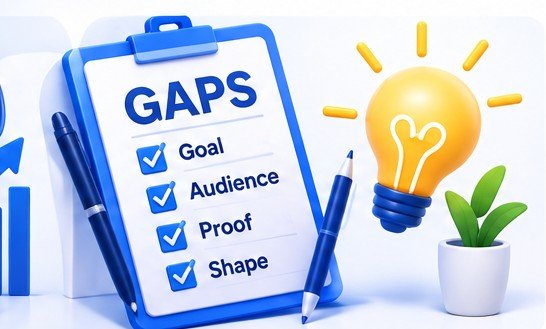
Most weak outputs come from weak briefs. The GAPS Brief is a four-part checklist for deciding whether a prompt is ready to send.
G is for Goal. State the one job the text has to do. “Get a cold lead to book a 15-minute call” is a goal. “Write something engaging” is not.
A is for Audience. Name who’s reading, where they live, what they already know and what worries them. A UK finance director and a first-time US freelancer need different words for the same product.
P is for Proof. Paste in the facts the model is allowed to use: real numbers, real quotes, real policies, with their dates. Then tell it to use only those. This is the part most people skip, and it’s the part that prevents invented claims.
S is for Shape. Say how long, what format, what tone, what to avoid and what to do when information is missing. “Write [NEEDS SOURCE] where you’d otherwise guess” is one of the most useful sentences in this whole article.
Prompts that include all four parts are more likely to produce focused, reviewable first drafts. If one is missing, the output tends to drift. Every prompt below is built on GAPS, with the proof slot marked so you can’t forget it.
If you want a wider look at writing prompts for everyday work, see How to Write Better AI Prompts for Business Tasks.
Prompts 1 to 6: Know the Buyer

Good marketing starts with what customers say, not with what the model imagines. These prompts help you organise your own research.
1. Customer pain map
Prompt: I sell [product] to [audience] in [country]. List the ten problems these buyers describe before they buy, grouped by urgency. For each, give a phrase they’d plausibly type into a search box. Mark anything you’re inferring so I can check it against real customer conversations.
Use it when you’re starting a campaign and need hypotheses to test, not facts to publish.
2. Interview question builder
Prompt: Write 15 interview questions for customers who bought [product] in the last 90 days. Focus on what they tried first, what nearly stopped them and what they’d tell a friend. No leading questions. Add one line saying what each question is meant to uncover.
Use it before you talk to five real customers. The questions come from the model; the answers must come from people.
3. Review mining
Prompt: Below are [number] real customer reviews I’m pasting in. Pull out recurring praise, recurring complaints and the exact wording customers use. Quote only phrases that appear in the text. Don’t add anything that isn’t there. [paste reviews]
Use it to find the language your customers already use. It’s among the most reliable prompts here because the model works from supplied text.
4. Competitor comparison grid
Prompt: Using only the competitor pages I’ve pasted below, build a table comparing [competitor names] on price, target customer, main promise and proof offered. Where the pasted text doesn’t say, write “not stated.” [paste text]
Use it for positioning work. Never let a model fill gaps from memory, because competitor prices and features change often.
5. Positioning drafts
Prompt: Write five positioning statements for [product] in this format: For [audience] who [need], [product] is the [category] that [benefit], unlike [alternative], because [reason to believe]. Use only the facts listed here: [facts].
Use it to get options for a team discussion. Pick one and test it in an ad before you rebuild a website around it.
6. Objection ranking
Prompt: List the 12 objections a sceptical buyer in [segment] might raise before buying [product]. Rank them by how likely they are to come up. For each, say what kind of proof would answer it: data, guarantee, demo or case study. Don’t invent any proof.
Use it to plan your FAQ and your sales page. Then check the ranking against what your sales team hears.
A caution for this group
A model can describe “typical buyers,” but those descriptions are averages of text it was trained on, not research on your market. Treat them as questions to ask, never as findings to quote.
Prompts 7 to 14: SEO and Content

Google’s guidance on AI content is clearer than many people assume. In its February 2023 post, Google said that using automation, including AI, to generate content mainly to manipulate search rankings breaks its spam policies, while content that’s helpful is judged on quality, however it was produced (Google Search Central).
The practical reading: AI is allowed, mass-produced filler isn’t, and “who wrote this and why” is a question your page should be able to answer.
7. Keyword clustering
Prompt: Group the keywords below into topic clusters by search intent: informational, comparison or transactional. Suggest one main page and up to five supporting pages per cluster. Don’t estimate search volumes. [paste keyword list]
Use it after you’ve exported keywords from a keyword tool. The model organises; the tool provides the data.
8. Content brief
Prompt: Write a content brief for the title [title]. Include the reader’s real question, the angle that would make this page different from what already ranks, an outline of H2 headings, facts I must verify with sources, and what the page should not claim.
Use it before any draft, human or AI. A good brief cuts rewrites.
9. Outline critique
Prompt: Here’s my outline. Act as a sceptical editor. Which sections repeat each other? What question would a reader still have at the end? Which claims will need a source? [paste outline]
Use it when you’ve drafted a structure yourself and want a second set of eyes.
10. Draft from notes
Prompt: Turn the notes below into a 900-word draft for [audience]. Use only facts that appear in the notes. Where a number, example or quote is needed and missing, write [NEEDS SOURCE] instead of supplying one. Keep paragraphs to five sentences or fewer. [paste notes]
Use it when you have expertise and sources but little time to write. It’s the safest way to get a long draft.
11. Title tags and meta descriptions
Prompt: Write ten title tags under 60 characters and ten meta descriptions under 155 characters for a page about [topic]. Use the keyword [keyword] once in each. No promises the page doesn’t deliver.
Use it for A/B ideas. Confirm current display limits in your search console documentation, since truncation rules shift.
12. FAQ block
Prompt: Suggest eight plausible questions people may ask about [topic]. Do not claim these are verified search queries. Mark any question that should be checked against Search Console, People Also Ask or customer research. Write a direct answer of 40 to 60 words for each, in plain language, and mark any answer that depends on law, price or date with [VERIFY].
Use it to draft candidate questions for a People Also Ask-style section. A model has no access to your real search data, so check the questions against Search Console, People Also Ask or customer research, and verify every flagged item before publishing.
13. Plain-language rewrite
Prompt: Rewrite this paragraph for a reader aged 12. Keep every fact. Break any sentence over 25 words. Add no new claims. [paste paragraph]
Use it on dense product or policy copy.
14. Freshness audit
Prompt: This article was published in [year]. List every statement likely to be out of date: prices, laws, product features, statistics, screenshots. For each, tell me what to check and where an official source would be.
Use it quarterly on your top ten pages. Updating beats publishing something new more often than people expect.
Prompts 15 to 20: Email and Lifecycle

Email is where fake urgency and invented social proof tend to creep in. These prompts close that door.
If you’re still building the audience these emails will go to, start with Grow Your First Email List in 2026: Complete Beginner Guide.
15. Welcome sequence
Prompt: Draft a five-email welcome sequence for new subscribers to [brand]. Email one delivers [lead magnet]. Later emails build trust using only this proof: [proof]. For each email give a subject line, preview text, a body under 120 words and one call to action.
Use it as your first automation. Read every email aloud before it goes live.
16. Subject line options
Prompt: Give me 15 subject lines for an email about [topic] to [audience], mixing curiosity, benefit and plain description. Keep them under 45 characters. No all-caps and no fake urgency.
Use it to build test variants. You’re after a spread, not a winner picked by the model.
17. Abandoned-cart series
Prompt: Write three abandoned-cart emails for [product], sent after 1, 3 and 7 days. The offer, if any, is [offer]. Don’t say stock is low or that an offer ends soon unless I’ve told you it’s true.
Use it when you have a real cart-recovery tool. Invented scarcity is a classic way to attract complaints.
18. Win-back email
Prompt: Write a win-back email for customers who haven’t bought in 180 days. Acknowledge the gap plainly, offer [specific value] and make unsubscribing obvious. Under 130 words.
Use it with a clean, consented list only.
19. Segment rewrite
Prompt: Rewrite this newsletter intro for three segments: [segment A], [segment B], [segment C]. Same facts, different emphasis. After each version, list what changed. [paste intro]
Use it when personalisation is limited to a few clear groups.
20. Single-variable test
Prompt: Create two versions of this email that differ in one variable only: [variable]. State the hypothesis, the metric and what result would make you choose each version. [paste email]
Use it to stop yourself changing five things at once and learning nothing.
Prompts 21 to 28: Ads and Social
Advertising rules apply to AI output exactly as they apply to a human copywriter’s. The UK’s Advertising Standards Authority put it bluntly in a June 2026 note: the advertising code is media-neutral, so the rules apply however the content was created, and advertisers stay responsible even when ads are produced through automated platforms (ASA and CAP).
That’s a UK source, and the CAP Code is not law in other countries. Still, the principle is a sound working rule for any market: you answer for what your ads say, however they were made.
21. Search ad copy
Prompt: Write ten headlines and four descriptions for a search ad for [product], staying inside the character limits of [platform] as listed on its current help page. Use only claims I can prove: [claims].
Use it to fill ad slots quickly. Check platform limits yourself; they change.
22. Blog-to-social conversion
Prompt: Turn this blog post into five LinkedIn posts, each with a different opening line, none longer than 150 words. Keep every factual statement exactly as the post has it and add none. [paste post]
Use it to repurpose work you’ve already fact-checked.
23. Hook options for short video
Prompt: Write 12 opening lines for a 30-second video about [topic] for [audience]. Group them: question, mistake, surprising fact (only from the source I’ve pasted) and a story prompt where I fill in a real experience.
Use it when you’re filming anyway and need a better first sentence.
24. One ad per objection
Prompt: Using the objections list below, write one short ad per objection that answers it with the proof I’ve supplied. Don’t exceed [word count]. [paste objections and proof]
Use it after prompt 6. It turns research into ads with a clear job.
25. Designer brief
Prompt: Write a one-page creative brief for a [format] ad covering the goal, audience, single message, tone, must-include proof, legal lines and what to avoid.
Use it to save a round of back-and-forth with your designer.
26. Comment reply drafts
Prompt: Draft replies to these ten comments in a calm, helpful voice. Make no promises about results. Flag any comment that needs a human decision, a refund or legal review. [paste comments]
Use it to speed up community management, with a person approving every reply.
27. Creator outreach
Prompt: Write a short outreach email to [creator] proposing a paid collaboration. State that it’s paid, what we’re asking for, the fee range [range] and that the post must be clearly marked as an ad.
Use it for influencer work. Undisclosed paid posts are a regulatory risk in many countries.
28. Local adaptation
Prompt: Adapt this post for audiences in [US], [UK] and [Germany]. Change spelling, units, currency and cultural references, not the facts. List every change you made. [paste post]
Use it for first-pass localisation. Have a native speaker review anything you publish in another language.
Prompts 29 to 34: Pages, Product and Sales Support
29. Landing page skeleton
Prompt: Write a landing page outline for [offer] aimed at [audience] with one goal: [goal]. Give a headline, a subheading, five benefit blocks tied to the proof below, an objection-handling section and a closing call to action. Proof: [proof]
Use it to get structure first, words second.
30. Product descriptions from specs
Prompt: Write a 60-word product description for each item below using only the specifications given. Don’t add materials, certifications or performance claims that aren’t listed. [paste spec table]
Use it for catalogues. The “only the specifications” line matters more than anything else in the prompt.
31. Real-customer review request
Prompt: Write a short message asking a real customer for an honest review of their experience with [product]. Don’t suggest what to say, don’t offer anything in exchange for a positive review and include a link placeholder.
Use it to collect genuine reviews. Never ask a model to write the reviews themselves.
32. Case study from an interview
Prompt: Turn this approved interview transcript into a 400-word case study with a headline, the problem, what the customer did and the result. Use only figures stated in the transcript and quote only exact words. [paste transcript]
Use it only after the customer has agreed in writing to the published version. Use the customer’s name, photo or company name only as far as that permission allows.
33. Sales follow-up
Prompt: Write three follow-up emails for a prospect who attended our demo of [product] but hasn’t replied. Each under 90 words, each adding one useful thing: a resource, an answer to a likely question, a short offer to help. No guilt-tripping.
Use it to keep sales contact respectful and useful.
34. Pricing page FAQ
Prompt: Write answers to these pricing questions using only the policy text I’ve pasted: [questions]. If the policy doesn’t answer a question, say so and suggest what I should decide.
Use it to find holes in your own policies before customers do.
Prompts 35 to 40: Measure, Check, Improve
This group is the one most people skip, and it’s the group that keeps the other 34 honest.
35. Campaign debrief
Prompt: Here are the results of our [campaign] with spend, impressions, clicks and conversions by channel. Summarise what happened in plain language, list three possible explanations for the best and worst results, and say what extra data would let us tell them apart. [paste data]
Use it for analysis support. The model doesn’t know your tracking setup, so ask it for hypotheses rather than conclusions.
36. Anomaly questions
Prompt: Our conversion rate fell from [x] to [y] in [period]. List 10 things to check, ordered from cheapest to most expensive to investigate, covering tracking, traffic mix, page changes, pricing and seasonality.
Use it as a checklist generator when something looks wrong.
37. Leadership summary
Prompt: Turn the figures below into a 150-word update for a non-marketing executive. Lead with the decision needed, then the evidence. Don’t round numbers in a way that changes the story. [paste figures]
Use it for monthly reports.
38. Test plan
Prompt: Design a two-week test for [change] on [page or email]. State the hypothesis, the single metric, the minimum sample you’d want before deciding, and what we’ll do if the result is unclear. Do not invent a statistically valid sample size. State your assumptions and explain when the available sample is too small to support a reliable conclusion.
Use it to avoid declaring winners on thin data.
39. Claims check
Prompt: List every factual claim in the draft below in a table with columns: claim, type (number, law, comparison, superlative, testimonial), evidence I’ve supplied, evidence still needed. Don’t judge truth. Just list what has support and what doesn’t. [paste draft]
Use it on everything before publishing. It’s the prompt that earns its keep fastest.
40. Rule-based compliance review
Prompt: Review the ad below against the rules I’m pasting. Flag anything misleading, unsupported or missing a disclosure, and quote the rule it may breach. Say clearly that you’re not giving legal advice. [paste ad and rules]
Use it as a first screen before your legal or compliance person sees the copy. It doesn’t replace that person.
The Review Ladder: How Much Checking Each Output Needs

Not every output needs the same care. Match the review to the risk. This is a simple decision rule: the higher the chance that someone is misled or harmed, the more human eyes it needs.
Review levels and typical content (framework, no data claims):
| Level | Typical content | Minimum review |
|---|---|---|
| 1 | Internal brainstorms, outlines, subject line ideas | One quick read by the person who asked |
| 2 | Blog posts, emails, social posts with no numbers | Edit by a second person and a fact check of every name and link |
| 3 | Anything with statistics, prices, comparisons, testimonials, health, money or legal claims | Source for every claim, named approver and, in regulated sectors, legal or compliance sign-off |
A small online shop uses prompt 30 for 200 product descriptions. The listings are Level 2 overall, but any description mentioning “waterproof,” “organic” or “safe for children” jumps to Level 3, because each of those words is a claim someone could challenge.
The shop pulls every such description for a check against supplier documents.
What the Rules Say: Law and Platform Policy
This section is general information, not legal advice. Confirm details with a qualified professional in your country, especially if you advertise in a regulated sector.
United States. The Federal Trade Commission’s final rule on consumer reviews and testimonials, announced in August 2024, bans fake or false reviews and testimonials. That includes those that misrepresent they’re from someone who doesn’t exist, such as AI-generated fake reviews. The rule took effect on 21 October 2024.
Knowing violations may expose businesses to civil penalties. The rule also covers buying fake social media followers or views in some circumstances. The marketing lesson is blunt: no prompt should ever ask for a customer quote you can’t trace to a real person.
United Kingdom. The ASA’s position, covered above, is that the same code applies to AI-made ads and that automation doesn’t shift responsibility away from the advertiser. If an AI-generated celebrity endorsement looks real enough to mislead, the ASA says it is likely to breach the code.
European Union. Article 50 of the EU AI Act applies from 2 August 2026. According to the European Commission, providers of AI systems must make sure people know when they’re interacting directly with AI and must add machine-readable marks to AI-generated content. Deployers must inform people about deepfakes and about text publications on matters of public interest that run without human review or editorial control.
These duties are not the same for every kind of AI-generated marketing material. Most ordinary ad copy isn’t “text on matters of public interest,” so don’t assume every email needs a label. But if you publish realistic AI-generated images or video of people, or run a customer-facing chatbot, take advice.
A limited transitional period until 2 December 2026 applies only to the machine-readable marking duty for generative AI systems that were already on the market before 2 August 2026. The other Article 50 duties apply from 2 August 2026.
Search platforms. Beyond Google’s spam policies, platforms such as social networks and ad networks have their own rules on misleading claims and AI-generated content. Read the current policy page of each platform you buy from before you scale.
Risks, Sorted by Size
Small risks. Bland, generic copy that blends in with everyone else’s. Cost: lower engagement and wasted edit time. Fix: put your own examples and numbers into the prompt.
Medium risks. Invented or outdated facts in published content, privacy slips when pasting data, and brand voice drift across channels. Cost: corrections, complaints, lost trust, platform rejections, and in some cases regulator attention. Fix: the review ladder and a standing rule on what data can be pasted.
Large risks. A fabricated testimonial, a false performance claim or an undisclosed paid endorsement in a regulated sector. Cost: regulator action, civil penalties where the law allows them, refunds, and damage to the brand that outlasts any campaign.
Worst realistic case: an enforcement action naming your company, plus the cost of removing every asset built on the claim.
Mistakes That Cost People Real Time and Money
A course seller asks a chatbot for “social proof” and publishes three student quotes. None of the students exist. A competitor points it out publicly. The seller deletes the posts, but the screenshots stay up, and under rules like the FTC’s, invented testimonials are exactly what regulators care about.
Lesson: ask for structure to place real quotes into, never for the quotes.
A recruiter pastes a spreadsheet of candidate names and emails into a free chatbot to “write personalised outreach.” The company’s data protection officer later finds out and has to assess whether a breach occurred.
Lesson: write the template with placeholders, then merge the personal details inside your own approved system.
A team publishes 300 near-identical city pages in a month, each drafted by AI from the same template. Traffic arrives, then fades, and several pages drop out of the index. Google’s guidance is about helpfulness and intent, and pages produced mainly to capture searches fit the pattern its spam policies describe.
Lesson: ten pages with real local detail beat 300 with swapped place names.
Another common mistake in AI marketing is skipping the test. A polished email that nobody tested against the old one is just a new email. Run the single-variable test in prompt 20 before you rewrite a whole programme.
Three Things Many Basic Prompt Lists Overlook
First, the proof slot. Many basic prompt lists focus on the instruction itself but give less attention to where the facts should come from. Without a facts block, the model fills the gap. The GAPS Brief puts proof in the middle of every prompt.
Second, the rules are already here. Older prompt lists often talk as if AI marketing is unregulated. By late 2026 there’s a US rule on fake reviews, a UK regulator saying the code applies to AI-made ads, and EU transparency duties now in force. A prompt library without a compliance check is incomplete.
Third, the review gap is the real story. If only 27% of AI-using organisations said in McKinsey’s 2024 survey that all generative AI content is reviewed before use, then the competitive edge isn’t who generates fastest. It’s who checks best.
Building a Prompt Library That Keeps Paying Off
Treat prompts as small company assets. Put them in a shared document with a name, the date, the tool and version used, the last person to edit it and a note on what happened when you used it. Keep the proof blocks separate in a “facts file” with dates, so you can update one place when a price or policy changes.
Retire prompts that produce the same mush each time. Promote the ones that consistently produce first drafts needing light edits. A good library is short. Twenty prompts used weekly beat 200 saved and forgotten.
If you want prompts written for a specific kind of work, try AI Prompts for Small Business Owners: 40 Examples or AI Prompts for Freelancers: 40 Examples. Founders building something new may prefer AI Prompts for Entrepreneurs: 50 Useful Examples.
Myths and Bad Advice
Myth: Google penalises anything written with AI. Google’s own guidance says the issue is using automation mainly to manipulate rankings, not the tool.
Myth: A longer prompt always gives a better answer. Clear beats long. Four tight GAPS parts usually outperform a rambling page.
Myth: Adding “don’t hallucinate” fixes accuracy. It doesn’t. Supplying the facts and demanding [NEEDS SOURCE] markers does far more.
Myth: Disclosing AI use cures a misleading claim. UK advertising bodies have said that disclosing AI use is very unlikely to fix a fundamentally misleading message, according to law-firm summaries of their guidance.
When to Stop Using AI for a Task
Stop or change course when edits take longer than writing from scratch, when outputs keep needing the same correction, when the content touches regulated claims you can’t verify, or when your audience reacts badly to a recognisably generic voice.
Moving a task back to a person isn’t failure. It’s the review ladder doing its job.
Your 90-Day Action Plan

- Weeks 1 and 2Pick one channel, such as email or blog content. Write your facts file: ten to twenty verified claims with source and date. Write your rule on what data may be pasted into AI tools. Target: one page each.
- Weeks 3 and 4Run prompts 3, 6 and 8 with real material. Hold five customer conversations using prompt 2. Target: a ranked objection list and three content briefs.
- Month 2Produce six pieces using the GAPS Brief: for example four emails and two posts. Put every piece through prompt 39 and the review ladder. Track edit time per piece. Target: edit time falling by the end of the month, with zero unsupported claims published.
- Month 3Run two single-variable tests (prompts 20 and 38) on one email and one landing page. Review results with prompt 35, but make the decision yourself. Prune your library to the 15 to 20 prompts you actually used. Target: a documented library, one test result you trust and a monthly review habit.
Expect mixed results. Some prompts will work immediately and some won’t suit your voice at all. That’s normal.
Your Checklist
Before you prompt, paste, publish and advertise
- Before you prompt: write the Goal, Audience, Proof and Shape.
- Before you paste: remove personal data, confidential details and customer identifiers.
- Before you publish: run the claims check (prompt 39), check every number against a source, read the copy aloud, confirm links work.
- Before you advertise: check the platform’s current ad policy and your country’s advertising rules.
- Before you use a testimonial: confirm it’s real, current and approved by the customer.
- After you publish: log what you used, what you changed and what happened.
Regional Considerations
United States. Federal consumer protection law covers misleading advertising, and the FTC’s reviews and testimonials rule explicitly reaches AI-generated fake reviews. State privacy laws may affect what customer data you can use in AI tools.
United Kingdom. The CAP Code is media-neutral, according to the ASA, and advertisers remain responsible for AI-generated content and for automated placements. UK GDPR applies to personal data.
European Union. The AI Act’s Article 50 transparency obligations apply from 2 August 2026, with the Commission publishing guidelines and a Code of Practice on AI-generated content. The GDPR applies to personal data. Rules also vary by member state, so check local advertising law.
Asia-Pacific, Middle East, Africa and Latin America. We haven’t verified rules for these regions for this article, so we haven’t made claims about them. Local advertising and data protection laws exist across all of them. Check your national regulator before running campaigns there.
Frequently Asked Questions
There’s no single best one, but the strongest prompts share four parts: a clear goal, a named audience, supplied proof and a defined shape. A prompt that includes your own facts and tells the model to flag missing information will beat any clever wording.
Start with prompt 39, the claims check, because it improves every other output.
Yes, in general. Using AI to write marketing copy isn’t banned, but you stay responsible for accuracy, privacy and compliance. Check every factual claim, avoid pasting personal data into unapproved tools, and never use AI to invent reviews or endorsements. Regulators in the US, UK and EU treat AI-made ads like any other ads.
Not by default. Google’s guidance says it rewards helpful, original content regardless of how it’s produced, and treats automation used mainly to manipulate rankings as spam.
In practice, that means adding real expertise, examples and checked facts rather than publishing large volumes of thin, near-identical pages made from a template.
Fake reviews or testimonials are not safe to use. In the US, the FTC’s rule bans reviews and testimonials that misrepresent who wrote them, including AI-generated ones from people who don’t exist. Ask real customers for honest reviews instead, and never offer payment for positive sentiment. Seek legal advice in your country.
It depends on the content and the country. In the EU, Article 50 requires disclosure for deepfakes and for some AI-generated text on public-interest matters published without human review. UK advertising rules have no AI-specific disclosure rule, but misleading ads are banned. Check your jurisdiction and platform policies before publishing.
You can’t stop it entirely, but you can reduce it. Paste in the facts you want used, tell the model to use only those, and have it write [NEEDS SOURCE] where information is missing. Then run a claims check and verify each number against a source. Human review remains the control that matters.
Only if your organisation has approved the tool for that kind of data and you have a lawful basis for using it. Under GDPR-style laws, personal data needs care. A safer habit is to write templates with placeholders and merge personal details inside your own approved email or CRM system.
Fewer than you might expect. A working marketer usually settles on 15 to 25 prompts they use regularly, covering research, briefs, drafts, email, ads and checks. Build from the 40 here, keep the ones that save you edit time, and drop the rest.
Final Summary
AI prompts for marketing work best when you treat them as a briefing skill, not a magic phrase. The 40 examples above cover research, SEO content, email, ads, landing pages and reporting, and each one asks you to bring something the model can’t: your real facts.
What can you realistically expect? Faster first drafts, clearer briefs, better organised research and a steadier publishing rhythm. What you shouldn’t expect is a guaranteed lift in traffic or sales, or a way to skip editing. The teams that benefit most are the ones that keep a human in charge of every claim.
Your next moves are small. This week, write a one-page facts file and a one-paragraph rule on what data may go into AI tools. Next week, take one prompt from each of the first three groups and run it on real material. Then put every output through the claims check in prompt 39 before it goes anywhere public.
The law is moving and the tools change every few months, so revisit your library quarterly. Keep what earns its place. Done that way, marketing prompts become what they ought to be: a quiet, dependable part of your workflow that makes your own expertise easier to share.
Sources and Further Reading
- McKinsey, The State of AI in 2025: Agents, Innovation, and Transformation
- Google Search Central, Google Search’s guidance about AI-generated content
- Federal Trade Commission, Final Rule Banning Fake Reviews and Testimonials
- UK ASA and CAP, AI and Deepfakes: Four Things Advertisers Need to Know
- European Commission, Guidelines on transparency obligations for providers and deployers of certain AI systems
- Read This Before You Start
- How to Read the Prompts
- The GAPS Brief: A Named Method for Any Marketing Prompt
- Prompts 1 to 6: Know the Buyer
- Prompts 7 to 14: SEO and Content
- Prompts 15 to 20: Email and Lifecycle
- Prompts 21 to 28: Ads and Social
- Prompts 29 to 34: Pages, Product and Sales Support
- Prompts 35 to 40: Measure, Check, Improve
- The Review Ladder: How Much Checking Each Output Needs
- What the Rules Say: Law and Platform Policy
- Risks, Sorted by Size
- Mistakes That Cost People Real Time and Money
- Three Things Many Basic Prompt Lists Overlook
- Building a Prompt Library That Keeps Paying Off
- Myths and Bad Advice
- When to Stop Using AI for a Task
- Your 90-Day Action Plan
- Your Checklist
- Regional Considerations
- Frequently Asked Questions
- Final Summary
- Sources and Further Reading
Share this article
Was this article helpful?
Private feedback for our team. It is not published. To discuss publicly, use the comments below.



Join the Discussion
1 comment
Share a question, a tip or what worked for you. Please keep it helpful and on topic.
No comments yet. Be the first to share your thoughts.