

Key Takeaways
- Global freelance platform revenue sits near $9.9 billion in 2026 and is projected to roughly double by 2030.
- AI-related freelance skills grew 109% year over year on Upwork, with AI video editing alone up 329%.
- Data analysis, data science, and machine learning remain the top three technical priorities among freelancers.
- 25 skills worth learning in 2026 with realistic rates, learning difficulty, and beginner-friendly guidance.
- Realistic timeline to first paid project plus costs, taxes, and platform fees nobody mentions.
- 90-day action plan and region-specific notes for US, UK, EU, Asia-Pacific, Middle East, and Africa.
Table of Contents
+- Introduction
- Read This Before You Start
- Freelance Skills at a Glance
- 1. AI Prompt Engineering and AI Workflow Design
- 2. AI Integration Development
- 3. AI Video Generation and Editing
- 4. Data Analysis
- 5. Data Science and Machine Learning
- 6. Full-Stack Web Development
- 7. No-Code and Low-Code App Development
- 8. UX/UI Design
- 9. Graphic Design
- 10. Video Editing (Traditional and Short-Form)
- 11. Copywriting and Conversion-Focused Writing
- 12. Content Strategy
- 13. SEO (Search Engine Optimization)
- 14. Social Media Management
- 15. Digital Marketing and Paid Ads Management
- 16. Email Marketing and Marketing Automation
- 17. Virtual Assistance (General and Specialized)
- 18. Bookkeeping and Financial Administration
- 19. Translation and Localization
- 20. Voiceover and Audio Production
- 21. Cybersecurity Consulting (Freelance)
- 22. Project Management (Freelance/Fractional)
- 23. E-commerce Store Management
- 24. Instructional Design and Online Course Creation
- 25. Podcast Production and Editing
- Where the Money Goes: Hidden Costs and Common Mistakes
- Your 90-Day Global Action Plan
- Your Comprehensive Checklist
- Regional Considerations
- Frequently Asked Questions
- Final Thoughts: Choosing the Right Freelance Skill in 2026
Most people who search “best freelance skills” are trying to answer one question before anything else: which skill, out of dozens of options, is worth the hours it takes to learn it. That’s a fair question, and it deserves a fair answer rather than a list dressed up as one.
The freelance economy isn’t a side conversation anymore. Independent workers now represent close to half the global workforce by some counts, and the freelance platform market alone is worth just under $10 billion this year, according to Research and Markets’ 2026 industry report. Depending on which research firm you ask, the broader gig economy — which includes ride-share drivers, delivery workers, and platform-based freelancers together — is valued anywhere from several hundred billion to well over half a trillion dollars. The numbers vary because “gig economy” and “freelance platform market” measure different things, and it’s worth being upfront about that instead of picking whichever figure sounds more impressive.
What hasn’t changed is the underlying shift: companies in the US, UK, and EU are hiring project-based talent instead of expanding headcount, largely because it lets them access specialized skills without the long-term cost of a full-time hire. Asia-Pacific is the fastest-growing region for this kind of work, and India’s gig workforce is expanding at roughly 21% a year as digital infrastructure reaches smaller cities, per Demandsage’s 2026 gig economy report.
At AiMoneyGuideCo, we track freelance income data across regions because readers keep asking the same practical question: not “is freelancing real,” but “which skill gets me paid the fastest, and how much can I actually expect to make.” If you’re exploring other ways to earn online, read our guide to realistic ways to make money online for 15 beginner-friendly options beyond freelancing.
One honest caveat before you read further: nobody can guarantee you a specific income. What we can offer is realistic ranges based on published platform data, a clear-eyed look at costs and risks, and a plan that doesn’t assume you have six months of runway to figure things out.
⚠️ Read This Before You Start
Freelancing is not a shortcut. The freelancers earning strong incomes in 2026 typically spent three to nine months building a portfolio and client base before seeing consistent monthly income. If someone promises results in two weeks, be skeptical.
Platform fees eat into your earnings. Upwork charges freelancers a sliding commission (roughly 5% to 20% depending on lifetime billings with a client), Fiverr takes a flat 20%, and payment processors like Wise or Stripe add currency conversion costs of 1% to 3% on cross-border payments. A $100/hour skill on a 20% commission platform nets you $80 before taxes.
Taxes are your responsibility, and they differ sharply by country. US freelancers file as self-employed and owe self-employment tax on top of income tax; UK freelancers typically register as sole traders with HMRC or form a limited company; EU freelancers face VAT registration thresholds that vary by country and must account for GDPR when handling client data. None of this is optional, and ignoring it early is one of the more expensive mistakes new freelancers make.
Data privacy matters more than most beginners assume. If you handle client data — customer lists, personal information, health records — you may be legally bound by GDPR (EU/UK clients) or CCPA (California clients) regardless of where you live. Use encrypted file transfer, avoid storing client data longer than necessary, and read the data processing clause in every contract.
Realistic timeline: expect your first paid project within 30 to 60 days if you’re actively pitching, a repeatable income stream by month four to six, and genuine rate growth by month nine to twelve. Anyone selling a faster path is usually selling something else.
Best Freelance Skills to Learn in 2026
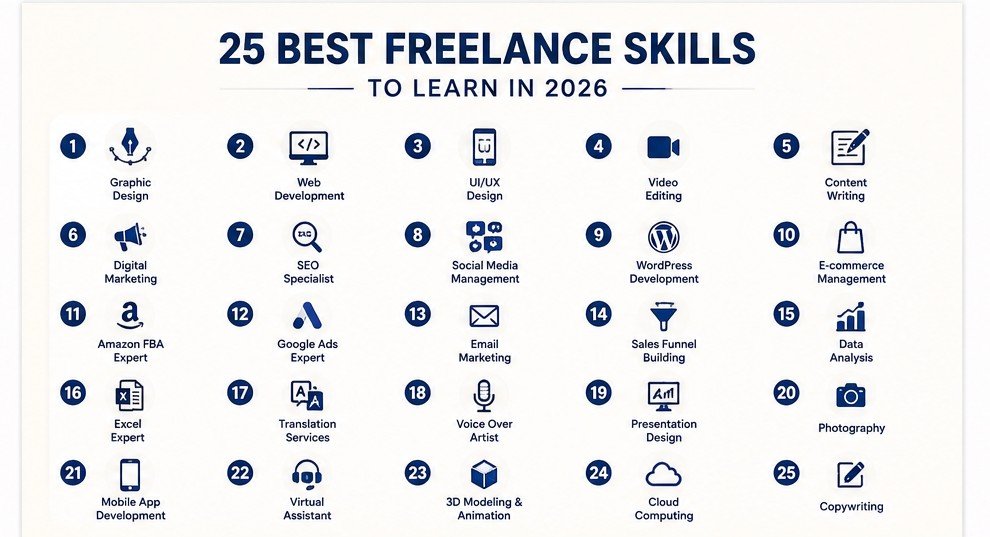
| # | Freelance Skill | Typical Rate* | Learning Difficulty | Beginner-Friendly? |
|---|---|---|---|---|
| 1 | AI Prompt Engineering & Workflow Design | $35–$150/hr | Medium | Yes |
| 2 | AI Integration Development | $130K–$190K annualized | High | No |
| 3 | AI Video Generation & Editing | $25–$75/finished minute | Medium | Yes |
| 4 | Data Analysis | $40–$90/hr | Medium–High | Yes |
| 5 | Data Science & Machine Learning | $100–$250/hr | High | No |
| 6 | Full-Stack Web Development | $50–$120/hr | High | No |
| 7 | No-Code & Low-Code Development | $30–$70/hr | Medium | Yes |
| 8 | UX/UI Design | $25–$100+/hr | Medium | Yes |
| 9 | Graphic Design | $20–$75+/hr | Medium | Yes |
| 10 | Video Editing | $50–$300/video | Medium | Yes |
| 11 | Copywriting | $50–$150/hr | Medium | Yes |
| 12 | Content Strategy | $1,500–$8,000/month | Medium–High | Yes |
| 13 | SEO | $40–$100/hr | Medium | Yes |
| 14 | Social Media Management | $15–$60/hr | Low–Medium | Yes |
| 15 | Digital Marketing & Paid Ads | $800–$5,000/month | Medium–High | Yes |
| 16 | Email Marketing & Automation | $35–$75/hr | Medium | Yes |
| 17 | Virtual Assistance | $10–$50/hr | Low | Yes |
| 18 | Bookkeeping & Financial Administration | $25–$50/hr | Medium | Yes |
| 19 | Translation & Localization | $0.05–$0.30/word | Medium | Yes |
| 20 | Voiceover & Audio Production | $50–$300/finished minute | Medium | Yes |
| 21 | Cybersecurity Consulting | $75–$200/hr | Very High | No |
| 22 | Freelance Project Management | $40–$90/hr | Medium–High | Yes |
| 23 | E-commerce Store Management | $20–$50/hr | Medium | Yes |
| 24 | Instructional Design & Course Creation | $40–$85/hr | Medium–High | Yes |
| 25 | Podcast Production & Editing | $25–$60/episode | Low–Medium | Yes |
Rates are indicative ranges drawn from the figures discussed in this guide and can vary significantly by experience, location, specialization, project scope, and client type.
1. AI Prompt Engineering and AI Workflow Design
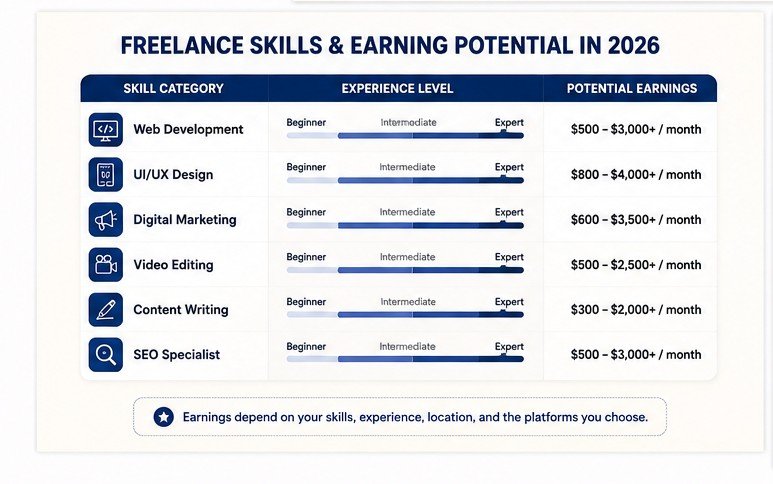
Businesses no longer just want someone who can “use ChatGPT.” They want freelancers who can design repeatable AI workflows — prompt chains, automation pipelines, and quality-control processes — that a non-technical team can run without breaking. Upwork’s In-Demand Skills 2026 report shows AI-related freelance work grew 109% year over year, and freelancers who pair AI fluency with a specific business function (marketing, legal, operations) are seeing the strongest demand. Entry-level projects start around $35–$60/hour in the US and UK; specialists working with enterprise clients report $80–$150/hour.
2. AI Integration Development
This is different from prompt engineering. AI integration developers connect large language models and AI APIs into existing software — customer service tools, internal dashboards, e-commerce platforms. Upwork reported 178% year-over-year growth in this category. It requires actual programming ability (Python or JavaScript, plus API experience), so it’s not a weekend skill, but the payoff is real: full-stack AI development roles are commanding $130,000–$190,000 in annualized freelance contracts, according to a 2026 freelance skills report from BestJobSearchApps.
3. AI Video Generation and Editing
The single fastest-growing skill category on Upwork in 2026, up 329% year over year. Tools like Runway, Pika, and Adobe’s AI video features have made this accessible to freelancers without a traditional film background, but clients still pay a premium for people who understand pacing, story structure, and brand tone — not just button-pushing. Rates for short-form AI-assisted video work range from $25–$75 per finished minute depending on complexity and region.
4. Data Analysis
Data analysis remains the single most cited priority among freelance tech workers, named by 14.2% of respondents in a Demandsage survey of Upwork freelancers — ahead of data science and machine learning individually. Small and mid-sized businesses need someone to turn spreadsheets and dashboards into decisions, and that need hasn’t gone away just because AI tools can summarize numbers faster. US freelance rates sit around $40–$90/hour; rates in the UK and EU run comparably once converted.
5. Data Science and Machine Learning
Named by 11.2% and 10.3% of surveyed freelancers respectively, data science and ML remain premium categories, especially for freelancers who can explain findings to non-technical stakeholders. This is a longer learning curve than most skills on this list — expect six months or more before you’re client-ready unless you already have a technical background — but the ceiling is high, with experienced freelancers billing $100–$250/hour.
6. Full-Stack Web Development
Full-stack development is consistently one of Upwork’s most-hired categories, not just fastest-growing. It’s a durable skill because every business, in every region, eventually needs a website, app, or internal tool built or maintained. US and UK rates range from $50–$120/hour; rates in South and Southeast Asia are typically lower in absolute dollar terms but often higher relative to local cost of living.
7. No-Code and Low-Code App Development
Platforms like Bubble, Webflow, and Airtable let freelancers build functional apps and websites without traditional coding. This lowers the barrier to entry considerably — a motivated beginner can become client-ready in six to ten weeks — while still commanding respectable rates, typically $30–$70/hour, because clients are paying for speed and problem-solving rather than raw code.
8. UX/UI Design
Fiverr listed UX design among its fastest-growing service categories for 2025 into 2026, and demand hasn’t slowed. What’s changed is the expectation that UX designers can work alongside AI tools — Figma AI, in particular — to move from concept to prototype faster. Rates vary widely by portfolio strength, from $25/hour for newer freelancers to $100+/hour for designers with recognizable enterprise clients.
9. Graphic Design
Graphic design is a mature, stable category rather than a fast-growth one — Upwork data shows it growing around 23% year over year, slower than AI-driven categories but still healthy. It remains one of the most accessible entry points into freelancing because the barrier to a first paid project is low. Realistic starting rates run $20–$45/hour, climbing toward $75+/hour with a specialized niche like packaging or brand identity.
10. Video Editing (Traditional and Short-Form)
Beyond AI-assisted editing, demand for skilled human editors — particularly for short-form content on platforms like TikTok, Instagram Reels, and YouTube Shorts — remains strong across every region in this guide. Businesses in the US and UK often pay per video ($50–$300) rather than hourly, while EU and Asia-Pacific clients more often use retainer arrangements.
11. Copywriting and Conversion-Focused Writing
Writing freelancing hasn’t disappeared with AI; it’s shifted. Clients increasingly want writers who can direct AI tools, fact-check output, and add a point of view AI can’t fabricate — plus writers who understand conversion psychology for sales pages and email sequences. Rates for skilled conversion copywriters range from $0.15–$0.75 per word or $50–$150/hour, well above general content writing.
12. Content Strategy
Fiverr named content strategy among its top five fastest-growing categories. This is a step above writing alone — it’s the ability to plan what content a business needs, when, and why, based on business goals rather than just SEO keywords. Freelance content strategists typically charge project or retainer rates from $1,500–$8,000/month depending on scope and region.
13. SEO (Search Engine Optimization)
SEO freelancing has evolved alongside AI-generated search results and Google’s shifting algorithm, but businesses still need someone who understands how to get found. Full-time freelance SEO contracts have reported salary-equivalent ranges of $110,000–$170,000 in the US market, according to the BestJobSearchApps 2026 report, with hourly freelance rates more commonly in the $40–$100/hour range for project work.
14. Social Media Management
Every region covered in this guide has small businesses that need a consistent social media presence but no internal team to run it. This is a genuinely global skill with steady, if not explosive, demand — rates run from $15–$20/hour in some Asia-Pacific and African markets to $30–$60/hour in the US, UK, and EU, with the gap partly reflecting cost of living rather than skill quality.
15. Digital Marketing and Paid Ads Management
Google Ads, Meta Ads, and increasingly TikTok and LinkedIn Ads management remain in steady demand because the skill directly and measurably affects revenue. Freelancers typically charge either a flat monthly retainer ($800–$5,000) or a percentage of ad spend (10%–20%), and experienced freelancers with case studies command the higher end regardless of region.
16. Email Marketing and Marketing Automation
As acquisition costs on paid ads climb, businesses are leaning harder on owned channels like email. Freelancers who can build automated sequences in tools like Klaviyo, HubSpot, or ActiveCampaign are seeing consistent demand, particularly from e-commerce clients in the US, UK, and EU. Typical rates: $35–$75/hour or $1,000–$4,000 per campaign build.
17. Virtual Assistance (General and Specialized)
General virtual assistance remains one of Upwork’s most-hired categories — not the highest-paying, but one of the most consistently available, which matters if your priority is steady income while you build a specialized skill on the side. Specialized VAs (e-commerce operations, executive support, bookkeeping-adjacent tasks) earn meaningfully more than generalists: $10–$20/hour for general VA work versus $25–$50/hour for specialized support.
18. Bookkeeping and Financial Administration
Small businesses in every region need someone to keep the books straight, and this work doesn’t require a full accounting degree — a bookkeeping certification plus fluency in QuickBooks, Xero, or a regional equivalent is often enough. It’s also one of the more recession-resistant categories on this list, since businesses cut discretionary spending before they cut bookkeeping. US and UK rates run $25–$50/hour.
19. Translation and Localization
With businesses expanding into new regions faster than their content teams can keep up, translation and localization freelancers — especially those who understand cultural nuance rather than literal translation — remain in steady demand. Rates vary enormously by language pair, from $0.05–$0.15 per word for common pairs like Spanish-English to $0.15–$0.30 for less common or technical pairs.
20. Voiceover and Audio Production
Demand for voiceover work has grown alongside podcasting, e-learning, and video content, and AI voice tools have — somewhat counterintuitively — increased demand for human voice talent who can prove authenticity and emotional range. Rates run $50–$300 per finished minute depending on usage rights and region.
21. Cybersecurity Consulting (Freelance)
This is a specialized, higher-barrier skill, but the payoff reflects that. Small and mid-sized businesses in the US, UK, and EU increasingly need freelance help with security audits, compliance reviews (especially GDPR-related), and basic penetration testing, and can’t always justify a full-time hire. Freelance cybersecurity consultants report rates from $75–$200/hour.
22. Project Management (Freelance/Fractional)
As companies rely more on distributed freelance teams, someone has to coordinate them — and “fractional project manager” has become a legitimate freelance category rather than a stopgap job title. This suits people with corporate project management experience who want to leave full-time employment without starting from zero. Rates: $40–$90/hour or $2,500–$6,000/month retainers.
23. E-commerce Store Management (Shopify, Amazon, Etsy)
Running a Shopify or Amazon storefront well is a distinct skill from building one, and it’s in steady demand as more small businesses launch direct-to-consumer brands. Freelancers who can manage listings, inventory syncing, and customer service on platforms like Shopify or Amazon Business report rates of $20–$50/hour, with specialists in Amazon PPC advertising earning more.
24. Instructional Design and Online Course Creation
As companies invest more in remote onboarding and training, instructional designers who can turn expert knowledge into structured, engaging courses are in demand — both from businesses building internal training and from individual experts building their own courses. Freelance rates range from $40–$85/hour or $3,000–$15,000 per full course build.
25. Podcast Production and Editing
Podcasting hasn’t slowed, and most hosts would rather pay someone else to handle editing, show notes, and distribution than learn it themselves. It’s one of the more accessible skills on this list to learn quickly — a motivated beginner can be client-ready within four to six weeks — with rates typically $25–$60 per episode for editing work, scaling up for full production packages.
Where the Money Goes: Hidden Costs and Common Mistakes
Even skilled freelancers lose income to preventable mistakes. Three come up often enough to name directly.
The first is undercharging in the first three months out of fear of losing a client. It’s an understandable instinct, but it trains clients to expect low rates permanently, and raising prices later is harder than starting closer to market rate.
The second is ignoring contracts, even for small projects. Scope creep — a client asking for “just one more thing” repeatedly — is one of the most common reasons freelancers end up working far more hours than they were paid for. A simple written agreement, even a one-page one, prevents most of this.
The third is treating taxes as a year-end problem. Freelancers in the US who don’t make quarterly estimated tax payments can face penalties even if they pay their full tax bill by April. UK sole traders face a similar issue with Payments on Account. Setting aside 25–30% of every payment in a separate account, from day one, avoids this entirely.
Your 90-Day Global Action Plan
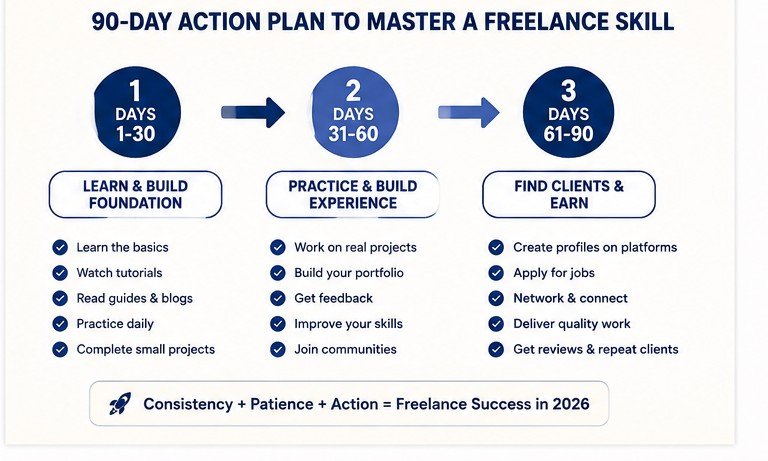
Days 1–14: Pick one skill from this list based on your existing background rather than pure earning potential — you’ll learn faster building on something you already understand. Set up profiles on two platforms (a general marketplace like Upwork or Fiverr, plus one niche community relevant to your skill). Build three portfolio pieces, even if they’re spec work, since most beginners don’t have real client examples yet.
Days 15–30: Apply to five to ten projects per week, prioritizing quality of pitch over volume. Register your business structure appropriately for your country (sole proprietorship or LLC in the US, sole trader in the UK, the equivalent in your EU country) so you’re not scrambling once income starts.
Days 31–60: Expect your first one to three paid projects in this window if you’re pitching consistently. Ask every satisfied client for a testimonial and, where appropriate, a referral. Start tracking income and expenses from your very first payment rather than waiting until tax season.
Days 61–90: Raise your rates by 10–20% for new clients once you have three to five completed projects and testimonials. Narrow your service offering toward whichever part of your skill got the best client response — generalists often plateau faster than specialists.
Your Comprehensive Checklist
Before your first project: choose a skill, build a portfolio, register your business, set up a payment method that handles international transfers (Wise, Payoneer, or Stripe), and set aside a separate savings account for taxes.
Before every contract: get scope, deliverables, timeline, and payment terms in writing, confirm who owns the finished work, and check whether the client’s data handling requirements (especially GDPR for EU/UK clients) apply to you.
Every month: track income and expenses, set aside your tax percentage, and review whether your rates still reflect your current skill level.
Regional Considerations
United States: Freelancers typically operate as sole proprietors or single-member LLCs, file Schedule C with the IRS, and owe self-employment tax (Social Security and Medicare) in addition to income tax. Quarterly estimated payments are required if you expect to owe $1,000 or more.
United Kingdom: Most freelancers register as sole traders with HMRC, though limited company structures can offer tax advantages above certain income levels — this is worth a conversation with an accountant rather than a guess. VAT registration becomes mandatory above the current threshold, which changes periodically, so check HMRC’s current figure directly.
Europe: EU freelancers face country-specific VAT rules, and cross-border service sales within the EU carry their own compliance requirements (reverse charge VAT, in many cases). GDPR applies to any freelancer handling personal data of EU residents, regardless of where the freelancer is based.
Asia-Pacific: This is the fastest-growing freelance region by several measures, with strong growth in India, the Philippines, and Southeast Asia broadly. Freelancers here often serve US and European clients directly, which means currency conversion and payment platform choice (Payoneer and Wise are widely used) matter more for take-home pay than in domestic-only markets.
Middle East: Free zones in the UAE and elsewhere have made it easier to formalize freelance work with proper licensing, which matters for freelancers working with larger regional or international clients who require formal invoicing.
Africa: Digital payment infrastructure has improved sharply, and mobile money platforms now coexist with international options like Wise and Payoneer, widening freelancers’ ability to work with global clients directly rather than relying solely on local marketplaces.
Frequently Asked Questions
Full-stack AI development and cybersecurity consulting report some of the highest rates on this list, with annualized freelance contracts reaching $130,000–$190,000 in the US market for AI development roles. That said, “highest paying” isn’t the same as “best for you” — a skill you can actually learn and deliver well will outearn a higher-ceiling skill you’re still struggling with a year from now.
Most freelancers land their first paid project within 30 to 60 days of consistent pitching, though this depends heavily on the skill chosen — no-code development and podcast editing tend to have shorter runways than data science or cybersecurity consulting.
For most skills on this list, no formal degree is required, though credibility-building credentials (Google’s UX certificate, HubSpot’s marketing certifications, or platform-specific certifications) can shorten the trust-building period with new clients.
It can be, but the transition typically takes six to twelve months of overlap, not a clean switch. Most successful full-time freelancers built their client base and income while still employed, rather than quitting first and figuring it out after.
Tax structure and VAT rules are the most practical differences. Income potential is broadly comparable once adjusted for cost of living and currency, though the US freelance market is currently the largest by volume of available work.
Final Thoughts: Choosing the Right Freelance Skill in 2026
Freelancing in 2026 rewards specificity over generality. The freelancers pulling ahead this year aren’t necessarily the most talented in the abstract — they’re the ones who picked a skill, built proof they can deliver it, and priced it honestly from the start.
Whichever of these 25 skills you choose, the fundamentals stay the same: build a clear portfolio, use a written contract for every project, set aside money for taxes from day one, and increase your rates as your skills and results improve. The right freelance skill isn’t simply the one with the highest earning potential; it’s the one you can learn, deliver well, and turn into a service clients are willing to pay for.
With a focused skill, consistent outreach, and realistic expectations, freelancing can become a sustainable source of online income rather than a short-term side hustle.