
Key Takeaways
- Digital assets take time. Most require four to twelve months of consistent effort before producing stable revenue.
- Choose the format that fits your skills. A blog, course, digital product, or SaaS tool each suit different strengths and timelines.
- Costs add up. Platform fees, payment processing, and taxes can take 10–30% of revenue depending on your region and channel.
- Early traction is engagement, not revenue. First sales from strangers, repeat visitors, or organic traffic are stronger signals than early dollar amounts.
- Plan for the slow months. Builders who succeed are the ones who planned for the quiet first year and kept showing up anyway.
Learning how to build digital assets can create opportunities to develop online income streams that are not directly tied to every hour you work. The process takes time, but with the right idea, validation, and consistent execution, a digital asset can become a valuable long-term business.
Table of Contents
+- Introduction
- What Is a Digital Asset?
- Read This Before You Start
- Choosing the Right Type of Digital Asset
- Table 1 — Which Digital Asset Is Right for You?
- The Market Opportunity, Region by Region
- Getting Started: The Tools You’ll Actually Need
- First Wins: What Early Traction Actually Looks Like
- Scaling: From First Sale to Repeatable Process
- Table 2 — Digital Asset Revenue Models
- International Expansion: What Changes When You Cross Borders
- Advanced Tactics: Bundling, Licensing, and Distribution
- The Honest Section: Losses, Hidden Costs, and Where Builders Give Up
- Competition and Time Investment: A Realistic Benchmark
- Your 90-Day Global Action Plan
- Table 3 — 90-Day Action Plan
- Your Comprehensive Checklist
- Regional Considerations
- Frequently Asked Questions
- Conclusion
Every economy right now is dealing with the same undercurrent: labor costs are rising, job security feels less certain than it did a decade ago, and more professionals are asking whether their income has to be tied entirely to hours worked.
That question isn’t new, but the tools available to answer it have changed. A freelance graphic designer in Lagos can sell templates to a buyer in Toronto before breakfast. A retired accountant in Manchester can license a spreadsheet template to small businesses in Singapore. None of this requires a factory, a warehouse, or venture capital.
If you’re still exploring different ways to earn online, our guide to realistic online income ideas can help you compare your options.
People often use the term “digital asset” loosely, so let’s define what it actually means.
In the business sense used here, a digital asset is something you build once—or build with periodic updates—that continues to generate revenue without your direct, hourly involvement in each sale.
That distinguishes it from freelancing or consulting, where income stops the moment you stop working. If you’re starting with freelancing, these freelance skills can help you choose a marketable skill.
Examples include an online course, a niche website earning ad or affiliate revenue, a mobile app with in-app purchases, a digital product library, a paid newsletter, or a software tool sold on subscription.
The available market data is mixed. Research from McKinsey on the digital economy has repeatedly pointed to a growing share of commerce moving toward platform-based and creator-driven models. However, exact figures on “digital asset income” specifically are harder to pin down because the category spans so many business types.
What’s more consistently documented is the failure rate: most attempts at digital products or content businesses stall out within the first year. Not because the idea was bad, but because the builder underestimated the gap between launch and traction.
At AiMoneyGuideCo, we’ve spent years studying what separates digital assets that continue becoming more valuable over time from ones that fizzle after a few months.
The reason is fairly simple, but shortcuts usually catch up with you. This guide sets out to be honest about both sides—the realistic upside and the very real costs, in time, money, and patience, that come before any of that upside shows up.
By the end of this guide, you’ll have a framework for choosing which type of digital asset fits your skills and available time. You’ll also get a breakdown of the platforms and tools used across different regions, a 90-day action plan, and a checklist you can return to at each stage.
We won’t promise a specific income figure, because anyone who does is guessing. What we can offer is a realistic view of what it really takes to build a digital asset that lasts.
How to Build Digital Assets: What You Need to Know
A digital asset is any online property or product you build that continues generating value—financial or otherwise—after the initial creation effort.
Unlike a service business, where you trade hours for dollars, a digital asset can be sold repeatedly without your direct involvement in every transaction. This is the core difference between freelancing and asset-building, and it’s also why digital assets are attractive to people who want income that isn’t tied to their time.
Digital assets come in many forms: a library of templates, a paid newsletter, an online course, a software-as-a-service tool, a content website, or a mobile app.
Some generate revenue directly through sales or subscriptions. Others generate income through ads, affiliate commissions, or licensing deals. What they all share is the characteristic that the value they produce grows over time, often without a proportional increase in the effort required to maintain them.
⚠️ Read This Before You Start
Before going further, it’s worth sitting with a few uncomfortable truths. Most digital assets take four to twelve months of consistent effort before they produce their first stable revenue.
Even then, that revenue is often modest—commonly under $200 a month at the six-month mark for content-based assets like blogs or YouTube channels. Software products and courses can move faster if there’s already an audience to sell to, but building that audience is its own multi-month project.
Costs add up faster than most beginners expect. Domain and hosting for a website typically run $80–$250 a year. Course platforms like Teachable or Thinkific charge either a flat monthly fee (roughly $29–$119/month) or a revenue share of around 5–10%.
Payment processors such as Stripe or PayPal generally take 2.9% plus a fixed fee per transaction. That fee structure varies by country—UK and EU merchants often see slightly different rates due to interchange regulations under PSD2.
App stores are steeper: Apple and Google both take up to 30% of in-app purchases and subscriptions in the first year. That drops to 15% after a subscriber’s first twelve months on Apple’s small business program.
Data privacy compliance isn’t optional if you’re selling internationally. If you have EU customers, GDPR applies regardless of where your business is based. That means clear consent mechanisms, a documented data retention policy, and the ability to delete a customer’s data on request.
California’s CCPA imposes similar obligations for US-based businesses above certain revenue or data thresholds. Ignoring this isn’t just a legal risk—platforms increasingly require compliance documentation before they’ll let you process payments at all.
Currency exposure is another quiet cost. If you’re pricing in USD but most of your audience is in the UK or Eurozone, exchange rate swings can shift your effective revenue by several percentage points month to month. Tools like Wise or Payoneer help reduce conversion fees, which otherwise sit around 3–4% with traditional bank transfers.
That may sound like a lot, but it doesn’t mean you shouldn’t start. It means going in with your eyes open about the real costs and timelines, so the inevitable slow months don’t feel like failure.
Choosing the Right Type of Digital Asset
There isn’t one correct format—there’s a format that fits your existing skills, the time you have available, and how much upfront capital you’re willing to risk.
A content-based asset like a blog or YouTube channel needs almost no money to start but a large amount of time before it earns anything. A digital product, like a template pack or an ebook, needs some design or writing skill but can generate its first sale within weeks if you already have an audience or a distribution channel.
Online courses sit in the middle. They require genuine expertise in a subject and the ability to structure that knowledge clearly. Platforms like Udemy or Skillshare provide built-in audiences, which shortens the path to first revenue considerably. The tradeoff is lower per-sale revenue, since these marketplaces take a significant cut and often run frequent discounts.
Software-as-a-service products carry the highest ceiling and the highest barrier. Building even a simple SaaS tool requires either coding skills or the budget to hire a developer, plus ongoing maintenance. But subscription revenue compounds in a way one-time product sales don’t, which is why so many long-term digital businesses eventually move in this direction.
Common mistake: Many first-time builders pick the format they find most exciting rather than the one that matches their actual skill set. They then abandon it three months in when the learning curve proves steeper than expected. Matching format to existing strength, even if it’s less glamorous, dramatically improves the odds of finishing.
How to Validate Your Idea Before Building
One of the most expensive mistakes you can make when building a digital asset is creating something before confirming that people actually want it.
It’s easy to spend weeks designing a course, writing an ebook, developing a small software tool, or creating dozens of templates. The difficult part is discovering that the finished product solves a problem that very few people are willing to pay to solve.
Validation helps you reduce that risk before you commit significant time or money.
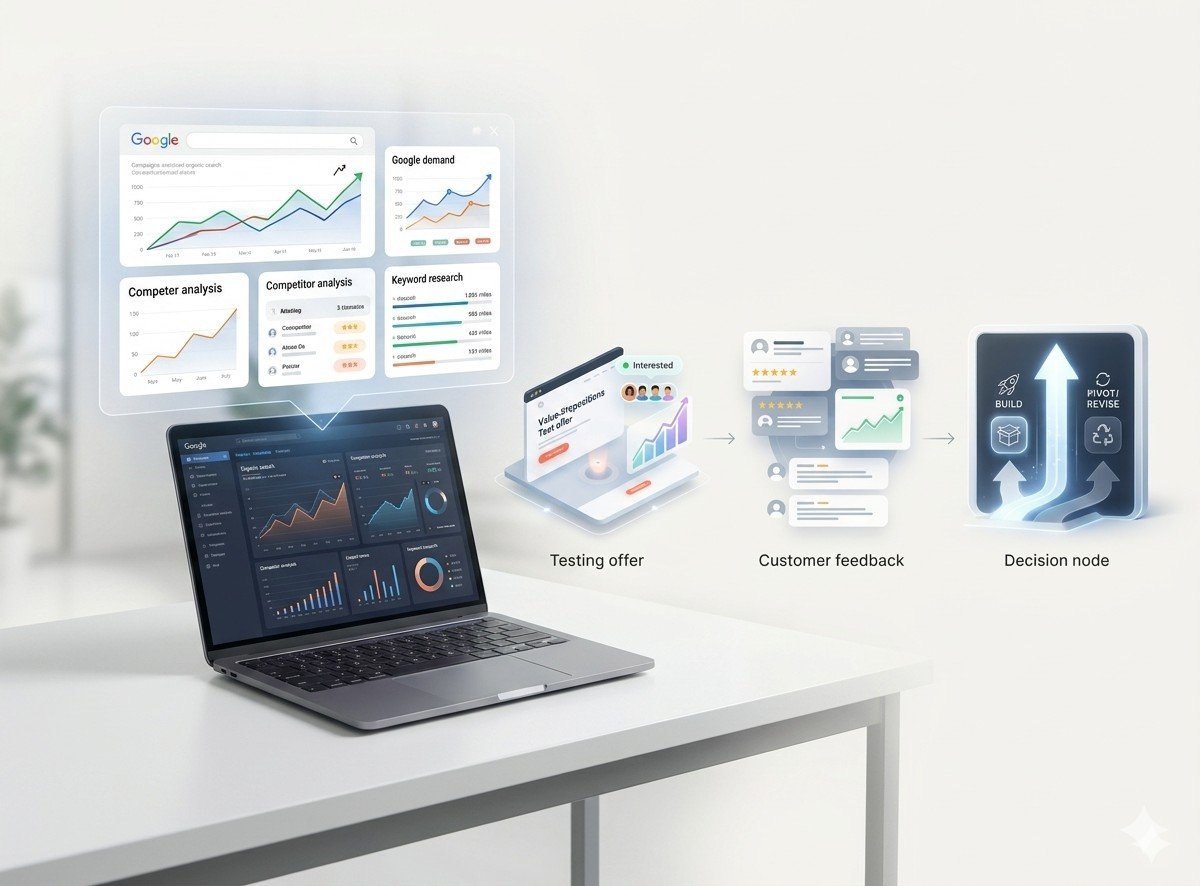
Start by looking at the market you want to enter. Search for products, services, websites, courses, templates, or tools that already solve a similar problem. Competition is not automatically a bad sign. In many cases, existing competitors are evidence that people are already spending money in that category.
The goal is not to copy what competitors are doing. Instead, look for gaps.
Read customer reviews, comments, community discussions, and questions related to competing products. Pay attention to repeated complaints. Customers may be asking for a feature that existing products lack, struggling with a confusing process, or looking for a simpler and more affordable alternative.
Those complaints can become useful opportunities.
Keyword research can provide another layer of evidence. Tools such as Google Keyword Planner, Google Trends, and search suggestions can help you understand what people are actively looking for. You don’t need thousands of searches every month to validate an idea. A smaller audience with a clear and valuable problem can sometimes be more attractive than a huge audience with weak buying intent.
You should also test the idea before building the complete product.
For example, if you want to create a collection of business templates, you could create a simple landing page showing what the finished library will contain and invite visitors to join a waitlist.
If you want to create a course, publish the outline and explain the specific problem the course will solve. If you can attract genuine interest before recording every lesson, you have stronger evidence that the idea deserves more investment.
A presale can provide even stronger evidence because it measures buying behavior rather than simple interest. Someone joining a free waitlist is useful information, but someone willing to pay for the solution provides a much stronger signal.
Validation does not guarantee success. Even a product with genuine demand can fail because of poor positioning, weak distribution, pricing problems, or execution. The purpose of validation is simply to reduce unnecessary risk and give you better information before you build.
A practical validation process can be as simple as this: identify the problem, study existing solutions, examine customer complaints, research search demand, create a basic offer, and test whether real people show enough interest to take the next step.
The important point is to avoid spending months building in isolation.
Build the smallest version that can test your main assumption. If people respond positively, improve the product based on what you learn. If the response is weak, change the offer, target a different audience, or reconsider the idea before investing further.
That approach turns validation into a learning process rather than a one-time decision.
For a digital asset business, the question is not simply, “Can I build this?”
The better question is, “Is there enough evidence that the right people want this, need it, and may be willing to pay for it?”
Answer that question before committing your full budget and time.
Building the Asset: A Realistic Process
Once you have validated the idea and found enough evidence that people are interested in the problem you want to solve, the next step is to build the asset itself.
This is where many beginners make another common mistake: they try to create the complete product before anyone has had a chance to use it.
A better approach is to start with the smallest useful version of the asset.
For an online course, that might mean creating three focused modules instead of recording a twelve-module program. For a template business, it could mean launching a small collection of useful templates rather than building a library of dozens of files. For a software product, it may mean solving one specific problem with one core feature instead of trying to create a complete platform.
The purpose of this first version is not to impress everyone. It is to learn whether the product actually works for the people you want to serve.
Your first version should be simple enough to finish, but useful enough to solve a real problem.
The timeline depends heavily on the type of digital asset you are building. A simple template pack or ebook may take only a few weeks, while an online course can require several weeks of writing, recording, editing, and testing. A content website may take months before enough useful content is published to attract meaningful search traffic. A software product usually requires even more time because development is followed by testing, bug fixes, maintenance, and future updates.
Don’t treat these timelines as guarantees. Your experience, niche, available time, technical ability, and existing audience can change the process considerably.
Your budget also depends on what you are building.
A digital product such as an ebook or template pack can often be created with inexpensive tools. A website requires a domain, hosting, and potentially paid tools for design, email marketing, analytics, or SEO. A course may require recording equipment, editing software, and a platform for hosting and delivering the lessons. Software can require considerably more investment if you need a developer or custom infrastructure.
Before you start building, write down the costs you expect to face. Separate essential expenses from optional upgrades. This prevents a common problem where a simple project becomes unnecessarily expensive because the creator keeps adding tools before the product has generated any revenue.
The build process should also include regular testing.
Don’t wait until everything is finished before showing it to potential users. Give early versions to a small group of relevant people and ask them where they get confused, what they find useful, and what they would change.
Their feedback can reveal problems that are difficult to notice when you are building the product yourself.
This is particularly important for digital assets because the creator often knows the product too well. Something that seems obvious to you may be confusing to a first-time customer.
After collecting feedback, improve the most important weaknesses first. Avoid adding features simply because they sound interesting. Every additional feature increases the amount of work required to maintain the asset.
A strong first version is therefore not necessarily the one with the most features. It is the one that delivers the core value clearly and reliably.
Once the first version is working, you can gradually improve it based on actual user behavior and feedback. Add useful features, improve the design, update outdated information, strengthen the sales page, and remove anything that does not contribute to the customer’s experience.
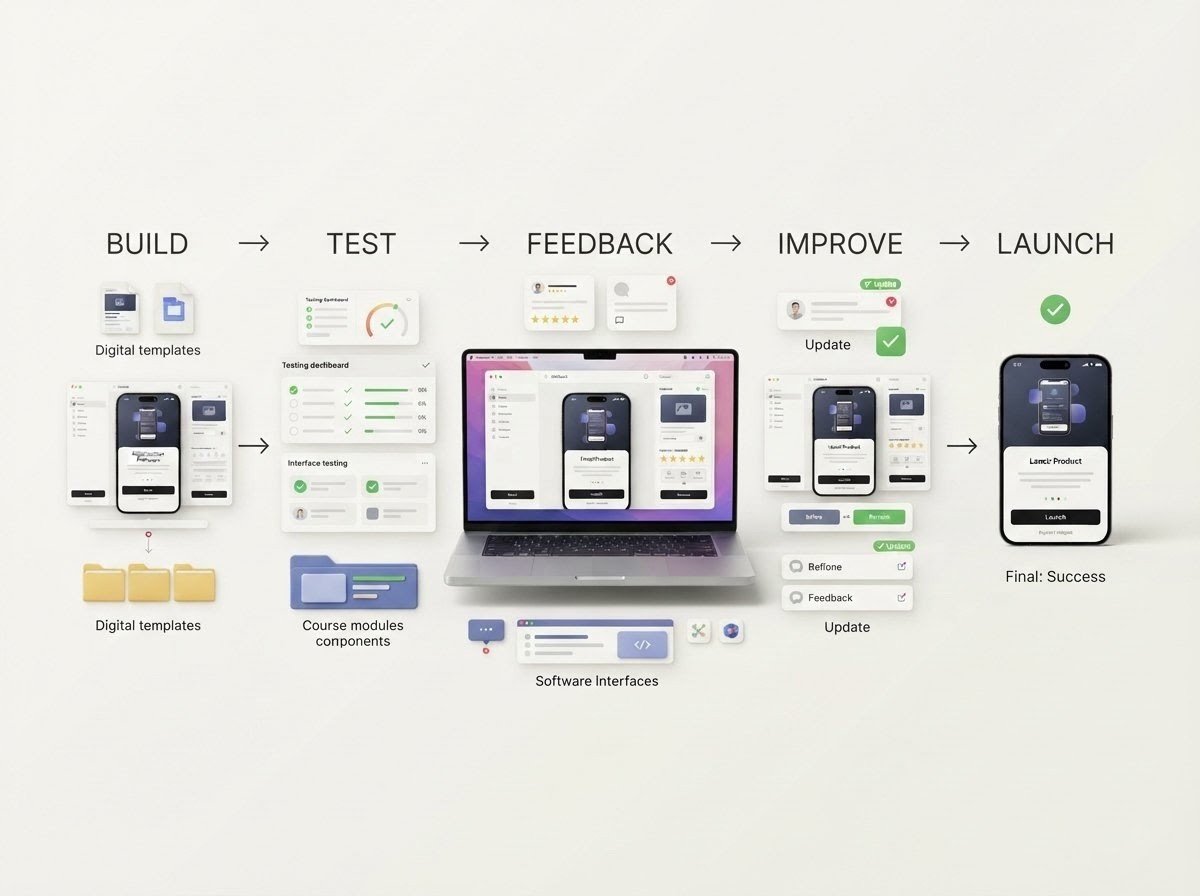
This creates a much more sustainable development cycle:
Build a small version, test it with real users, learn from the feedback, improve the product, and then expand what is already working.
That process may feel slower than trying to build everything at once, but it usually reduces wasted effort and gives you better information at every stage.
The goal is not to finish the biggest possible digital asset.
The goal is to build something useful, get it into the hands of real people, and improve it until the value becomes strong enough to support a sustainable business.
Table 1 — Which Digital Asset Is Right for You?
| Digital Asset | Startup Cost | Time to Build | Income Model | Best For |
|---|---|---|---|---|
| Niche Website | Low | Medium | Ads/Affiliate | Writers/SEO |
| Digital Products | Low | Low–Medium | One-time sales | Designers/Creators |
| Online Course | Medium | Medium–High | Course sales | Experts/Teachers |
| Newsletter | Low | Medium | Subscription/Sponsors | Writers |
| Mobile App | Medium–High | High | Subscription/IAP | Developers |
| SaaS | High | High | Monthly subscription | Technical founders |
The Market Opportunity, Region by Region
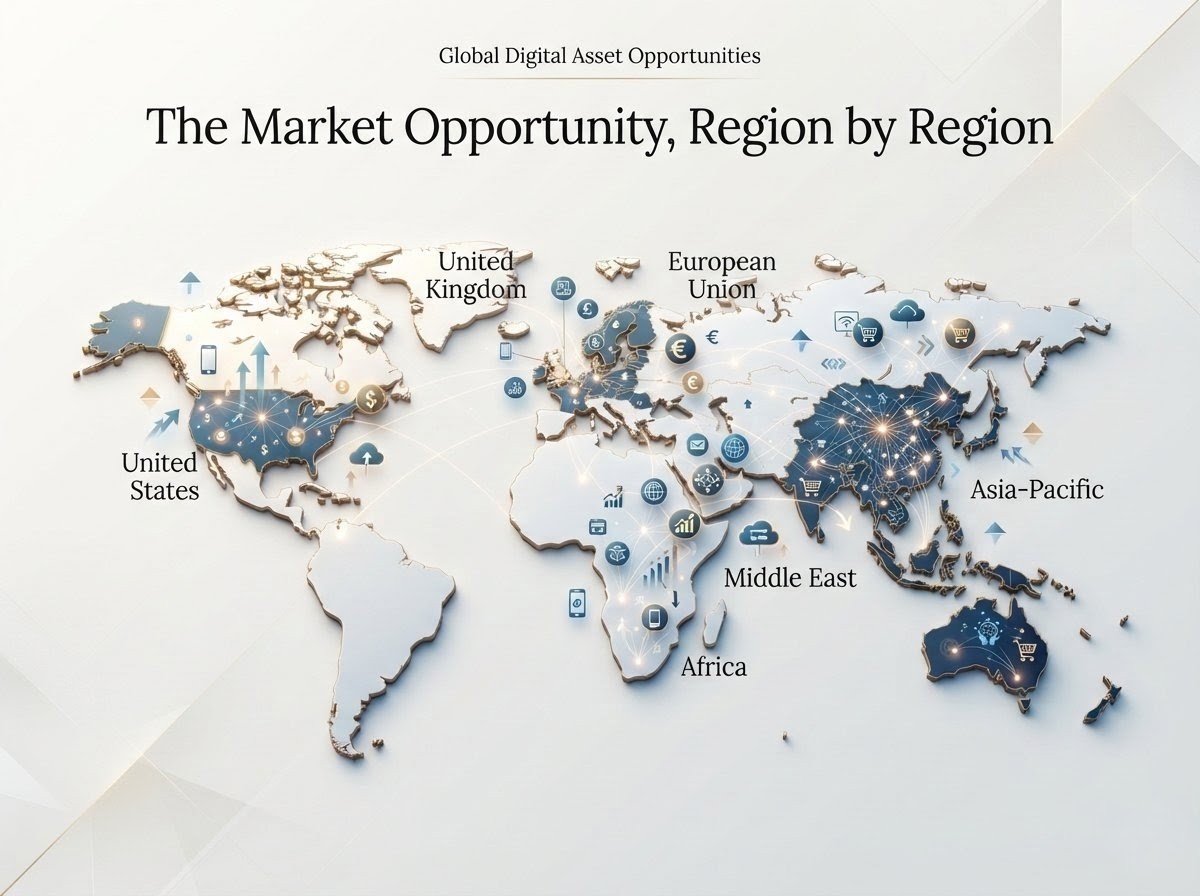
The opportunity looks different depending on where you and your audience are based.
In the US, digital product sales benefit from a large English-speaking market and mature payment infrastructure. However, competition is correspondingly fierce—nearly every niche has an established player.
The UK market is smaller but shows strong willingness to pay for professional-grade digital tools, particularly in finance and productivity categories.
Across the EU, language fragmentation is both a challenge and an opening. Localizing a product into German, French, or Spanish often unlocks a market with comparatively less competition than the English-language space. Of course, this requires either translation budget or genuine language skills.
Asia-Pacific markets, particularly India, Indonesia, and the Philippines, show fast-growing demand for affordable digital education and productivity tools. These are often at price points 30–50% lower than US or UK equivalents.
Manufacturing and supply chain knowledge from this region also translates well into a niche content or consulting-adjacent digital asset. These are aimed at Western buyers trying to source products.
The Middle East, particularly the UAE free zones, has become an attractive base for digital entrepreneurs due to favorable tax treatment. Dubai’s free zones offer 0% corporate tax on qualifying income up to certain thresholds. However, the rules changed with the UAE’s 2023 corporate tax reforms, so current regulations should be checked before relying on them.
Africa’s digital economy is growing quickly around mobile-first commerce. Countries like Nigeria and Kenya show strong adoption of digital payment platforms such as Flutterwave and M-Pesa. These lower the barrier for local creators to sell internationally.
Getting Started: The Tools You’ll Actually Need
You don’t need an expensive stack to begin.
A domain name and basic hosting (Bluehost, Hostinger, or similar) covers a website. For course creation, Teachable, Podia, or Thinkific handle hosting, payment, and delivery in one package. Canva covers most design needs without requiring professional design software.
For payments, Stripe remains the most globally flexible option, supporting over 45 countries directly. PayPal serves as a reasonable backup for regions Stripe doesn’t yet serve.
Email remains, somewhat unfashionably, one of the highest-return tools available. A basic plan on ConvertKit or MailerLite costs under $30 a month for the first few thousand subscribers. It gives you a direct line to your audience that isn’t subject to a platform’s algorithm changes.
First Wins: What Early Traction Actually Looks Like
Your first useful sign may not be revenue. It may be people actually engaging with what you built.
A blog post that starts ranking on page one of Google for a specific long-tail phrase. A course module that gets finished by most students who start it. A digital product that a stranger, not a friend or family member, buys without being asked.
These early signals matter more than early dollar amounts because they tell you the asset has a pulse independent of your personal network.
A verified example: the UK-based productivity template business Sunsama started as a simple planning tool built by a two-person team. It grew through consistent content marketing and direct user feedback before becoming a subscription SaaS product used internationally. The founders have spoken publicly about the multi-year runway before the business reached meaningful scale—a useful reminder that “digital asset” doesn’t mean “quick asset.”
Scaling: From First Sale to Repeatable Process
Once an asset shows early signal, the next phase is turning one-off wins into a process you can repeat.
This usually means documenting what worked—which headline, which price point, which traffic source—and doing more of it deliberately. You want to avoid hoping the next attempt gets lucky too.
For content-based assets, this often looks like building a content calendar around proven topics. For product-based assets, it means testing price points methodically rather than guessing.
This is where automation can start saving you real time. Tools like Zapier or Make can connect your sales platform to your email list, your accounting software, and your customer support inbox. A sale doesn’t require you to manually update five different systems.
This is also the stage where many builders start outsourcing narrow tasks—editing, customer support, or bookkeeping. This frees their own time for the work that has the biggest impact on growth.
Common mistake: Scaling too many channels at once. A builder who starts posting on five social platforms, launching paid ads, and pursuing partnerships simultaneously often ends up doing all of them poorly. Depth on one or two channels tends to outperform shallow presence across many.
Table 2 — Digital Asset Revenue Models
| Revenue Model | How It Works | Recurring? | Example |
|---|---|---|---|
| One-Time Sales | Customer buys once | No | Ebook |
| Subscription | Customer pays monthly/yearly | Yes | SaaS |
| Advertising | Earn from traffic/views | Potentially | Blog |
| Affiliate | Commission from referrals | Potentially | Niche website |
| Licensing | Others pay to use your asset | Yes/Potentially | Templates |
| Membership | Customers pay for ongoing access | Yes | Premium community |
International Expansion: What Changes When You Cross Borders
Selling into a new region isn’t just a translation exercise.
Tax obligations shift—EU sales of digital products, for instance, generally require charging VAT based on the buyer’s location under the EU’s OSS (One Stop Shop) scheme, not your own. Getting this wrong doesn’t just risk a fine; some payment processors will suspend accounts that show a pattern of VAT non-compliance.
Pricing psychology also shifts by region. A course priced at $199 might perform well in the US but need repricing closer to local purchasing power in Southeast Asia or parts of Africa to convert at a comparable rate. Platforms increasingly support purchasing power parity pricing, which automatically adjusts displayed prices by country—Gumroad and Podia both offer versions of this.
Customer support expectations differ too. European buyers, accustomed to strong consumer protection law, tend to expect clear refund policies stated upfront. US buyers are comparatively more tolerant of “all sales final” digital product policies, though clarity still reduces chargebacks everywhere.
Advanced Tactics: Bundling, Licensing, and Distribution
Once a single digital asset is stable, bundling related products often increases average order value without proportional extra work. A course paired with a template library, sold as one package, frequently outperforms either sold alone.
Licensing is another option many creators overlook. Rather than selling a finished product directly to end users, licensing the underlying content or template to other businesses (white-label arrangements) can create a second revenue stream from the same original work.
Distribution through marketplaces and other platforms trades a percentage of revenue for reach you couldn’t otherwise access. There is a downside, though: Amazon, Udemy, and app stores can take 15–30% of each sale. But for many builders, that’s a reasonable price for distribution they’d otherwise spend months building themselves.
The Honest Section: Losses, Hidden Costs, and Where Builders Give Up
It’s worth naming the failure points directly rather than glossing over them.
The most common one is underpricing out of fear of rejection, which caps revenue even when demand is healthy. The second is neglecting maintenance—a course or app that isn’t updated for two years starts losing relevance and refund requests climb.
The third, and probably the most common reason builders quit entirely, is comparing month three of their own project to month thirty of someone else’s. They don’t account for the years of unseen work behind an apparent overnight success.
Common mistake: Treating a digital asset as “done” after launch. Nearly every durable digital asset we’ve studied required ongoing iteration—updated content, refreshed design, responsive customer support—for at least eighteen months before it reached a stage where it needs less day-to-day work.
Hidden costs worth budgeting for include chargebacks (typically 0.5–1% of transaction volume, higher in higher-risk categories), software subscriptions that quietly accumulate, and the accounting or bookkeeping time needed once revenue crosses a few thousand dollars a month and simple spreadsheets stop being sufficient.
Competition and Time Investment: A Realistic Benchmark
Across the content-based digital asset category specifically, a commonly cited (though not universally agreed-upon) industry benchmark suggests it takes roughly 20–40 hours per week for 6–12 months to reach a stable few hundred dollars a month in revenue, if built alongside consistent audience growth.
That number varies enormously by niche competitiveness. A broad topic like “personal finance” faces far more competition than a specific one like “tax planning for remote workers relocating within the EU.”
Product-based digital assets, if there’s an existing audience to sell to, can move faster—sometimes producing meaningful revenue within the first month. But without an audience, the timeline converges with content-based assets, because you still need to build a reliable way to reach potential customers.
Your 90-Day Global Action Plan
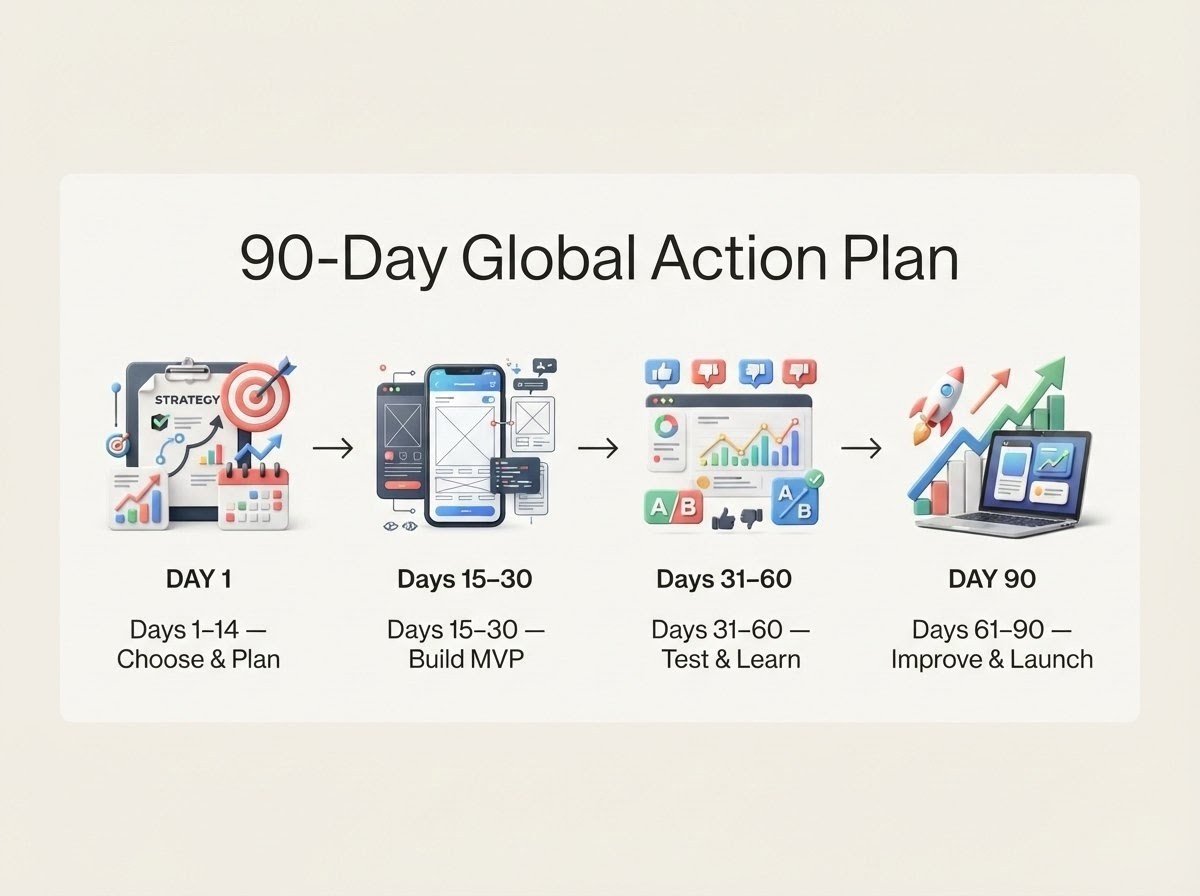
Days 1–14: Choose your asset type based on an honest audit of your skills and available weekly hours. Register your domain, set up your payment processor, and confirm what tax registration (VAT, sales tax, or none) applies in your home country. Draft your first piece of content or product outline.
Days 15–30: Build the minimum viable version of your asset. For a course, this might be a single module. For a product, a first working template or tool. Set up your email capture and a basic landing page. Publish your first piece of public content.
Days 31–60: Publish consistently—aim for a fixed, sustainable cadence rather than an aggressive one you can’t maintain. Start collecting feedback from the first handful of users or readers. Adjust pricing or positioning based on what you learn. Set up basic analytics to see where traffic or sign-ups originate.
Days 61–90: Review your data. Double down on whichever channel produced the best-quality engagement, not just the highest volume. Launch or relaunch your paid offer with refined messaging. Document your process so far—this becomes the foundation for the systemization phase that follows month three.
Table 3 — 90-Day Action Plan
| Period | Main Goal | Key Actions | Expected Output |
|---|---|---|---|
| Days 1–14 | Choose & Plan | Pick asset, domain, payments, tax research | Clear business direction |
| Days 15–30 | Build MVP | Create first version, landing page, email capture | First usable asset |
| Days 31–60 | Test & Learn | Publish, collect feedback, track analytics | Early traction data |
| Days 61–90 | Improve & Launch | Refine offer, pricing and promotion | Repeatable system |
Your Comprehensive Checklist
- Business structure and tax registration confirmed for your home country
- Domain, hosting, and payment processor set up and tested with a real transaction
- Privacy policy and terms of service published, covering GDPR/CCPA if applicable
- Refund policy clearly stated before first sale
- Email capture system in place before driving traffic
- First piece of content or product live and publicly accessible
- Pricing benchmarked against at least three comparable offerings
- Basic analytics tracking installed
- A realistic 90-day content or launch calendar drafted
- A bookkeeping method chosen, even if it’s a simple spreadsheet to start
Regional Considerations
United States: Most solo builders start as a sole proprietorship before forming an LLC once revenue becomes consistent, largely for liability protection. The IRS requires reporting income regardless of business structure. Platforms issue 1099-K forms once you cross federal reporting thresholds, which have shifted in recent years, so it’s worth checking current IRS guidance directly.
United Kingdom: Registering as a sole trader with HMRC is the simplest starting point, with the option to convert to a Limited company later. VAT registration becomes mandatory once turnover crosses the current threshold. Digital services sold to EU consumers may still require separate VAT handling post-Brexit.
European Union: The OSS scheme simplifies VAT collection for digital sales across member states. GDPR compliance is not optional and applies from your very first EU customer, not just at scale.
Asia-Pacific: Payment infrastructure varies significantly by country—India’s UPI system, for instance, dominates domestic transactions. A product aimed at Indian buyers often needs local payment support beyond Stripe or PayPal alone.
Middle East: UAE free zones offer attractive tax treatment for digital businesses. The specific thresholds and qualifying criteria have changed with recent corporate tax reforms, so current advice from a local accountant matters more than general guidance here.
Africa: Mobile money platforms like M-Pesa and Flutterwave are often more relevant than traditional card payments for reaching local customers. Building support for them can meaningfully expand your potential customer market within the region.
Frequently Asked Questions
Most builders see their first sale within one to three months if they have an existing audience or clear distribution channel, and four to twelve months if starting from zero. Stable, predictable income typically takes six to eighteen months of consistent work.
Not necessarily before your very first sale, but you should understand your home country’s tax obligations from day one. In the US and UK, many builders operate as a sole proprietor or sole trader initially, formalizing later once revenue justifies it.
Payment processing fees (roughly 2.9% plus a small fixed amount per transaction) are close to unavoidable across almost every processor. Marketplace fees (15–30%) are avoidable if you sell directly through your own site, at the cost of needing to drive your own traffic.
Yes, though the timeline stretches accordingly. Builders working 5–10 hours a week generally take two to three times longer to reach the same milestones as those working closer to full-time hours.
VAT. EU sales of digital products generally require charging VAT based on the buyer’s country under the OSS scheme, while most US states don’t apply sales tax to digital products the same way, though a growing number now do—rules here shift frequently enough that current confirmation is worth the ten minutes it takes.
Conclusion
Building something that keeps producing value after the initial effort is done isn’t a shortcut, and treating it as one is usually where things go wrong.
The builders who make it through the slow first year tend to share the same trait: they kept showing up on the unglamorous days, not just the days when the idea felt exciting.
What separates a digital asset that compounds for years from one that quietly disappears usually isn’t a better idea—it’s whether the person behind it treated the first six months as infrastructure-building rather than a verdict on whether the whole thing was worth doing.
Wherever you’re building from—a home office in Austin, a co-working space in Lagos, a kitchen table in Manchester—the fundamentals hold steady. Match the format to your actual skills. Budget honestly for the fees and taxes that come with your region. Expect the first stretch to feel slower than you’d like, because for almost everyone, it is.
At AiMoneyGuideCo, the pattern we keep seeing across markets is straightforward: the digital assets that last are the ones built by people who planned for the slow months before they arrived, not the ones who got lucky and avoided them.