

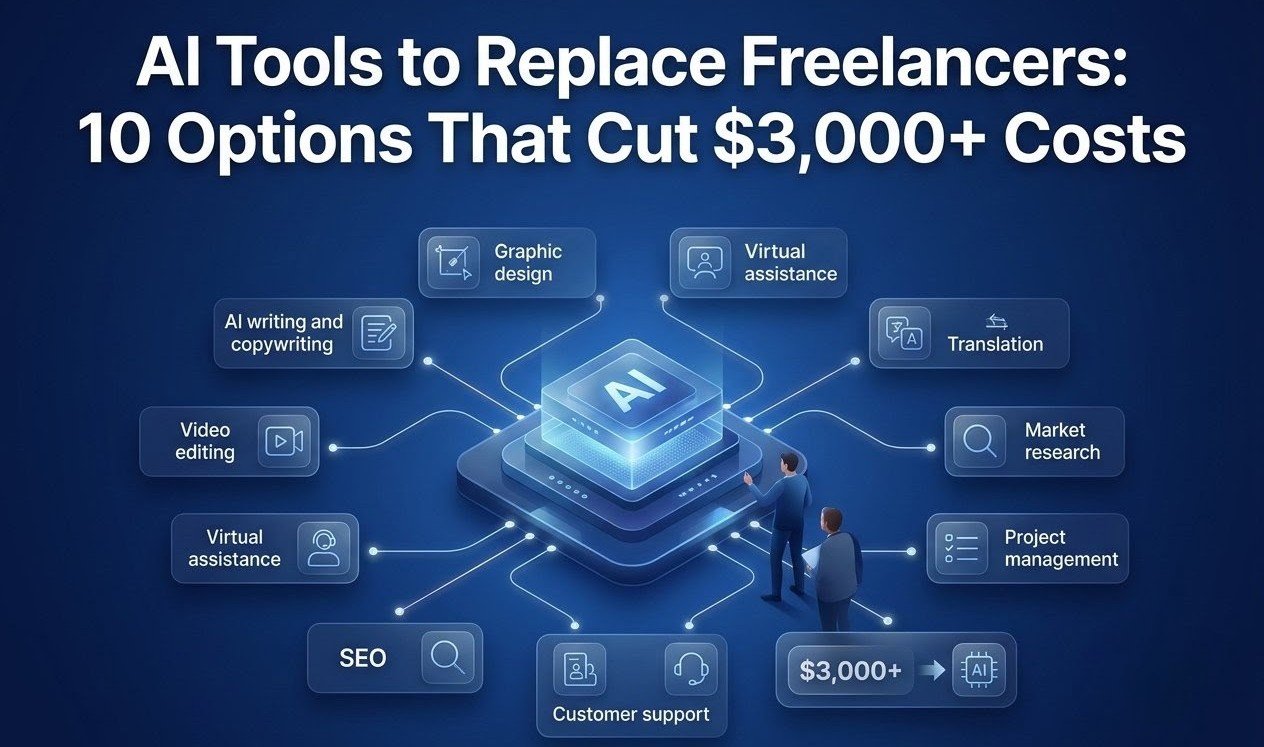
KEY TAKEAWAYS
- Small businesses often spend $3,000+ monthly across writing, design, SEO, and admin support.
- AI tools absorb the repetitive 60–70% of a role, not the entire job.
- A realistic transition combines AI with reduced human review — not a full swap.
- Routine drafts and basic design automate well. Tax filing and legal work do not.
- Review data-privacy terms before sending client data into any AI system.
AI tools to replace freelancers have changed the math for small businesses. Running a small business usually means paying for help you cannot yet justify hiring full-time. A freelance writer for the blog. A designer for social graphics. Maybe a virtual assistant to keep the inbox from taking over your day.
Individually, these feel manageable. Added up, they can easily reach $3,000 to $5,000 a month before a business has the revenue to comfortably absorb it.
That math is shifting. AI tools built on large language models and generative design systems can now produce usable first drafts, graphics, and reports in a fraction of the time a freelancer would need.
This is changing which parts of a freelance budget are worth paying for and which parts a business owner can reasonably automate.
In most cases, AI tools that replace freelancers do not eliminate the role outright. They absorb the repetitive 60 to 70 percent of a job while a human stays responsible for the parts that require judgment, brand knowledge, or accountability.
A freelance copywriter’s job includes research, structure, tone, and editorial judgment — not just typing sentences. AI can help with the typing. It is less reliable on the judgment.
This guide walks through ten categories where AI tools for small business are changing the freelance-versus-automation decision, what current pricing looks like, where the tools fall short, and how a business can transition without sacrificing quality.
If you are evaluating AI tools to replace freelancers, the figures below are estimates and typical ranges based on published tool pricing and public freelance marketplace data. They are not a guarantee of what any specific business will pay or save.
Read This Before You Start
A few things worth understanding before adjusting any freelance contracts.
There is a learning curve. Getting AI output to match what you were paying a freelancer for typically takes real time spent building prompts, templates, and review habits.
Subscriptions are recurring. Most business-relevant AI tools cost $15 to $200 a month per tool. A full workflow often needs two or three tools working together, not just one.
Free tiers often use your data for training. Many AI providers reserve the right to use free-tier conversations to improve their models unless you opt out or upgrade to a paid business tier with a no-training guarantee.
Some tasks still need a licensed professional. Tax filing, contract review, and regulated compliance work are not places to remove human accountability, regardless of how capable a tool seems.
Currency note: figures are in USD. If you are pricing this out in GBP, EUR, or AUD, expect roughly similar numbers with normal exchange-rate variation.
Freelance Cost vs. AI-Assisted Cost: A Starting Comparison
The ranges below come from public freelance marketplace data and current published AI tool pricing as of September 2026. Actual costs vary by market, workload, and experience level.
Treat this as a planning reference, not a quote.
| Freelance Category | Typical Freelance Cost | AI Tool Cost (approx.) | Human Role Still Needed |
|---|---|---|---|
| Content writing | Roughly $25–$160/hr, often $1,500–$4,000/mo | $20–$60/mo | Editing, fact-checking, brand voice |
| Graphic design | Often $1,500–$4,000/mo | $15–$25/mo | Original branding, print production |
| Video editing | Often $2,000–$5,000/mo | $20–$40/mo | Storytelling judgment, narrative cuts |
| Virtual assistant | Roughly $1,500–$2,500/mo part-time | $10–$30/mo | Client relationships, judgment calls |
| SEO consulting | Often $1,000–$3,500/mo | $50–$200/mo | Strategy, competitive positioning |
These numbers are directional. A copywriter charging $25/hr for entry-level blog content and one charging $150/hr for conversion copywriting are not interchangeable.
1. AI Writing Tools vs. Freelance Copywriters

What the freelancer does: Freelance writers research a topic, structure an argument, match a brand’s voice, and revise based on feedback.
Public marketplace data puts hourly freelance copywriting rates anywhere from $25 an hour for entry-level content up to $150+ an hour for experienced conversion copywriters.
Regular monthly retainers for blog or web content often land between $1,500 and $4,000.
What AI can realistically automate: Drafting outlines, generating first-pass copy from a clear brief, summarizing research, and producing variations of existing content.
Tools like ChatGPT (Plus plan, $20/month) or similar AI writing assistants can meaningfully cut first-draft time.
What it still does poorly: Original reporting, verifying facts against current sources, matching a nuanced brand voice consistently, and knowing when a claim needs a citation.
Where human expertise remains important: Anything involving specific expertise (legal, medical, financial content), original interviews, or brand-critical messaging.
Who benefits most: Businesses producing high volumes of routine content — product descriptions, social captions, internal documentation.
When replacing the freelancer is a bad idea: If your content is a primary trust signal (a law firm’s website, a medical practice’s patient materials), removing experienced human writing oversight introduces real risk.
A small business currently paying a freelancer roughly $3,000 a month for four long-form blog posts might instead pay $20–$60 a month for an AI writing tool, plus a reduced freelance or in-house editing budget. This is an illustration, not a documented case study.
2. AI Design Tools vs. Freelance Graphic Designers

What the freelancer does: Produces branded social graphics, ad creative, presentation decks, and marketing collateral. Often on a monthly retainer of $1,500 to $4,000 depending on volume and market.
What AI can realistically automate: Canva’s Magic Studio (included in Canva Pro, $18/month for one user as of 2026) can generate social graphics, resize designs across formats, and remove backgrounds automatically. This covers a large share of routine day-to-day content needs.
What it still does poorly: Original brand identity work — logos, full visual systems, anything that needs to scale cleanly across print and digital and hold up over years.
AI-generated designs can also drift toward generic-looking output without careful prompting and curation.
Where human expertise remains important: Core brand assets, packaging design, anything requiring print production knowledge.
Who benefits most: Businesses with a high volume of repetitive, lower-stakes visual content — daily social posts, simple ad variations.
When replacing the freelancer is a bad idea: For a first-time logo or full brand identity. Mistakes here are expensive to fix later and a trained designer’s judgment on scalability and print behavior is hard to substitute.
Transition approach: Keep a designer for foundational brand assets and templates, then use AI tools to produce daily variations within that established system.
3. AI Video Editing vs. Freelance Video Editors

What the freelancer does: Cuts long recordings into short-form clips, adds captions, and handles basic color correction. This traditionally took two to four hours of freelance time per finished short clip.
What AI can realistically automate: Automated captioning, clip selection from long-form recordings, and rough-cut assembly.
Tools like Descript and various AI-assisted editors have made meaningful progress here, generally priced in the $15–$40 a month range for individual plans.
What it still does poorly: Nuanced pacing, emotional storytelling arcs, and editorial judgment about what to cut for a specific audience.
Longer-form or narrative-driven video (brand documentaries, testimonial pieces) still benefits from a human editor’s sense of rhythm.
Who benefits most: Businesses producing high volumes of short-form social content from existing raw footage or webinar recordings.
When replacing the freelancer is a bad idea: For hero brand videos, ad campaigns, or anything where pacing and emotional tone directly affect conversion.
4. AI Virtual Assistants vs. Human VAs

What the freelancer does: Manages email triage, scheduling, data entry, basic research, and often some client-facing communication. Part-time freelance VA arrangements commonly run $1,500 to $2,500 a month.
What AI can realistically automate: Calendar scheduling, drafting routine email responses, basic data entry, and simple research summaries. AI scheduling assistants and inbox tools typically cost $10 to $30 a month.
What it still does poorly: Anything requiring relationship context. Remembering a client’s preferences from three conversations ago, reading tone in a sensitive email, or making a judgment call about how to handle an unusual request.
Who benefits most: Solo founders and small teams whose VA work is mostly administrative rather than relationship-driven.
When replacing the freelancer is a bad idea: When your VA is effectively managing client relationships or handling situations that require discretion.
A realistic transition keeps a reduced-hours human VA for judgment calls and escalations, while AI tools absorb the scheduling and inbox triage that used to consume the bulk of billable hours.
5. AI SEO Tools vs. Freelance SEO Consultants

What the freelancer does: Keyword research, technical site audits, content gap analysis, and backlink strategy. Freelance SEO consulting commonly runs $1,000 to $3,500 a month depending on site size and competitiveness.
What AI can realistically automate: Keyword clustering, on-page content suggestions, and basic technical audits. SEO platforms with AI features (Surfer SEO, Semrush’s AI tools, and similar) typically run $50 to $200 a month for small-business tiers.
What it still does poorly: Judging which competitive strategy will actually move rankings in a specific niche, negotiating backlinks, and adapting strategy when search algorithms shift.
Who benefits most: Businesses that need ongoing content optimization and basic technical hygiene rather than an aggressive competitive SEO push.
When replacing the freelancer is a bad idea: In competitive niches where a consultant’s market-specific experience and relationships provide value a tool cannot replicate.
6. AI Customer Support vs. Freelance Support Agents

What the freelancer does: Handles order status questions, basic troubleshooting, and FAQ-style tickets. Often for $15 to $30 an hour or a flat monthly retainer depending on ticket volume.
What AI can realistically automate: This is one of the stronger cases on this list. AI support tools (Intercom’s Fin, Zendesk AI, and similar) can resolve a meaningful share of repetitive, low-complexity tickets without human involvement.
Pricing is typically usage-based — often charged per resolved conversation rather than a flat monthly fee, so costs scale with volume.
What it still does poorly: Emotionally charged complaints, refund negotiations, and anything requiring a judgment call outside a documented policy.
Who benefits most: Businesses with high ticket volume and a narrow range of common questions (e-commerce order status, subscription management).
When replacing the freelancer is a bad idea: For high-touch B2B accounts where a human relationship is part of the product experience.
Most businesses that adopt AI support tools keep a smaller human team specifically for escalations rather than removing people from support entirely.
7. AI Bookkeeping vs. Freelance Bookkeepers

What the freelancer does: Categorizes transactions, reconciles accounts, and prepares basic financial reports. Typically $300 to $1,500 a month depending on transaction volume and business complexity.
What AI can realistically automate: Modern accounting software (QuickBooks, Xero, and similar) now includes AI-assisted transaction categorization and anomaly flagging. This can reduce the manual bookkeeping hours needed each month.
What it still does poorly: Tax strategy, handling ambiguous transactions that need judgment, and anything involving multi-jurisdiction compliance.
Where Human Expertise Is Essential
Tax filing specifically. In the United States, the IRS holds the business owner responsible for accuracy regardless of what software was used. In the UK, HMRC compliance obligations work the same way. AI software can speed up categorization, but it does not carry professional liability or replace the accountability a licensed professional provides.
Who benefits most: Straightforward small businesses with high transaction volume but low complexity (a single-location retail business, for example).
When replacing the freelancer is a bad idea: Any business with multi-state or multi-country tax exposure, or anything beyond simple pass-through taxation.
8. AI Translation and Localization vs. Freelance Translators
What the freelancer does: Translates and culturally adapts marketing copy, product descriptions, and business communication for new markets.
What AI can realistically automate: Straightforward business content — product descriptions, standard emails, basic marketing copy — where AI translation tools have improved substantially in recent years.
What it still does poorly: Legal documents, contracts, and culturally sensitive marketing where nuance and local idiom matter. Machine translation still makes context errors that a native speaker would catch immediately.
Who benefits most: Businesses translating high-volume, lower-stakes content like product catalogs.
When replacing the freelancer is a bad idea: Legal contracts, regulatory filings, or marketing entering culturally distinct markets (parts of Asia-Pacific, the Middle East, and Africa) where a misstep can carry real reputational or legal cost.
A native-speaking human reviewer is worth the cost here.
9. AI Market Research vs. Freelance Research Analysts
What the freelancer does: Synthesizes industry reports, summarizes competitive landscapes, and sometimes conducts primary research (surveys, interviews).
What AI can realistically automate: Summarizing publicly available secondary research and generating a first-pass competitive landscape overview. This speeds up desk research meaningfully.
What it still does poorly: Original primary research. AI cannot conduct a genuine customer interview or run a valid survey.
Current AI models can produce confident-sounding but inaccurate summaries of source material, so any output still needs verification against original sources.
Who benefits most: Early-stage market scoping where speed matters more than depth.
When replacing the freelancer is a bad idea: When a business needs validated primary research to make a major investment decision.
10. AI Project Management vs. Freelance Project Coordinators
What the freelancer does: Tracks timelines, generates status updates, and coordinates across team members. Often $1,500 to $3,000 a month on smaller teams.
What AI can realistically automate: Many project management platforms now include AI features that auto-generate status summaries, flag timeline risks, and turn meeting notes into action items. This cuts down administrative tracking time.
What it still does poorly: Resolving cross-team conflict, managing stakeholder expectations, and reading the room when a project is quietly going off track.
Who benefits most: Small teams whose coordination work is mostly administrative tracking.
When replacing the freelancer is a bad idea: Complex, cross-functional projects where a coordinator’s relationship-building and conflict resolution is doing real work.
Task vs. Capability: A Quick Reference
| Task | AI Can Generally Handle | Human Still Needed |
|---|---|---|
| First-draft blog content | Yes | Editing, fact-checking, voice |
| Original brand identity design | No | Yes, throughout |
| Routine customer support tickets | Yes | Escalations, complaints |
| Tax filing and compliance | No | Yes, licensed professional |
| Social media graphics | Yes | Brand consistency review |
| Contract translation | No | Yes, native-speaking professional |
| Meeting note summaries | Yes | Follow-up and prioritization |
Calculating Realistic Savings
It is tempting to compare a $3,000 freelance invoice directly against a $20 AI subscription and call the difference “savings.” For AI tools to replace freelancers, that comparison is misleading in most cases, because a full replacement rarely happens.
Current freelance cost — minus AI software cost — minus human review or editing cost — minus your own time spent managing the new workflow = approximate net savings.
This is a simplified framework, not a guaranteed return-on-investment formula.
A hypothetical example: a business spending $3,000 a month on content might move to $50 a month in AI tools plus $700 a month for a part-time editor. That is a hypothetical net reduction of roughly $2,250 a month, before accounting for the time spent managing the new workflow.
Again, this is illustrative, not a documented result. Your own numbers will depend on your content volume, complexity, and how much editing your specific output needs.
Privacy and Security Considerations
Data handling policies differ significantly between AI tools, and between the free and paid tiers of the same tool. Before feeding any customer or client information into an AI system, it is worth checking a few things.
Before You Send Client Data
- Whether the tool’s free tier uses your inputs for model training
- The provider’s data retention period
- Whether the vendor offers a data processing agreement, which matters for GDPR compliance
- Whether the tool stores data in a specific region, which can matter for certain compliance requirements
This is not legal advice, and specific requirements vary by jurisdiction and industry. If you handle regulated data (health records, financial account details, children’s data), consult someone qualified in data privacy law before adopting new AI tools for that workflow.
Regional Considerations
This section provides general information only and is not legal or tax advice. Rules vary by jurisdiction and change over time. Verify current requirements with official sources or a qualified professional.
Tax and accounting automation should still involve a licensed accountant for filing, since the IRS holds the business owner accountable regardless of the software used.
Similar principle applies for HMRC filings. Automation can speed up bookkeeping, but VAT and self-assessment filings benefit from continued professional review.
Data protection requirements under GDPR apply to any AI tool processing EU residents’ personal data. Review the vendor’s data processing terms, and note that requirements can vary by member state for certain business types.
Businesses expanding into new Asia-Pacific markets should have AI-translated content reviewed by a native speaker before publishing, given how varied language and business norms are across the region.
Business setup and free zone regulations vary significantly by jurisdiction. AI compliance tools are not a substitute for local legal counsel when establishing a new entity.
Digital payment infrastructure and regulatory environments vary widely by market. Test AI-driven invoicing and payment tools against locally used platforms before full adoption.
In all regions: “requirements vary by jurisdiction” is the honest answer more often than a specific rule. Local professional advice is worth the cost for anything tax, legal, or compliance-related.
Your 90-Day Action Plan
Weeks 1–2: Audit your current freelance spending by category. List exactly what each freelancer delivers monthly, and at what cost.
Weeks 3–4: Pick one category and test an AI tool alongside your existing freelancer, rather than replacing them outright.
Weeks 5–8: Compare AI-assisted output against freelancer output for quality, turnaround time, and how much revision it needs. Build templates or prompt libraries based on what actually worked.
Weeks 9–10: Where AI performed reliably, reduce freelance hours in that category rather than eliminating them entirely. Keep a reduced human role for review.
Weeks 11–12: Apply what you learned to a second category.
Ongoing: Review the workflow quarterly. AI tool capabilities and pricing both change quickly, and a category that was not ready three months ago might be worth revisiting.
Frequently Asked Questions
Rarely in full. Most businesses see the best results when AI tools absorb the routine, repeatable share of the work, while a person stays responsible for review, strategy, and anything requiring judgment.
It depends heavily on the category and how much human review the output still needs. A realistic estimate accounts for AI software costs, reduced (not eliminated) human review time, and the time spent managing the new workflow.
Routine content drafting, basic social media graphics, and first-pass customer support tend to automate well because the work is repetitive and low-stakes if occasionally imperfect.
Tax filing, legal translation, brand identity design, and anything requiring a nuanced judgment call or professional liability are hardest to replace responsibly.
Often yes for routine tasks, but rarely by the full freelance cost. Factor in the human review time that most AI-assisted workflows still require.
Most consumer-facing AI writing, design, and support tools are built for non-technical users and require no coding knowledge. The learning curve is usually about prompting and workflow, not technical setup.
It depends on the specific tool and plan. Review the vendor’s data retention and training policies before sending confidential client or customer information into any AI system. Prefer paid business tiers with documented data protection terms for sensitive work.
Where This Leaves Small Business Owners
It is tempting to compare a $3,000 freelance invoice directly against a $20 AI subscription and call the difference “savings.” For AI tools to replace freelancers, that comparison is misleading in most cases, because a full replacement rarely happens.
Businesses that get the most value from this shift tend to treat it as a gradual reallocation of budget rather than an overnight cutover. Testing one category, measuring the real cost including human review time, and only then scaling to the next.
The savings are real for a lot of routine work. They are just rarely as large, or as immediate, as a subscription price alone would suggest.
For most small businesses weighing AI tools to replace freelancers against keeping their current setup, the honest answer sits somewhere in between. Automate what is repeatable, keep a person accountable for what is not, and reinvest whatever you save into the parts of the business that still need a human’s judgment to get right.
For a related angle on building income with these tools, see our guide on how to build passive income with AI tools in 2026.
If you are weighing digital product models instead of service work, our breakdown of how to make money selling digital products in 2026 covers that path in detail.
- Freelance Cost vs. AI-Assisted Cost
- 1. AI Writing Tools vs. Copywriters
- 2. AI Design Tools vs. Graphic Designers
- 3. AI Video Editing vs. Video Editors
- 4. AI Virtual Assistants vs. Human VAs
- 5. AI SEO Tools vs. SEO Consultants
- 6. AI Customer Support vs. Support Agents
- 7. AI Bookkeeping vs. Bookkeepers
- 8. AI Translation vs. Translators
- 9. AI Market Research vs. Analysts
- 10. AI Project Management vs. Coordinators
- Task vs. Capability Reference
- Calculating Realistic Savings
- Privacy and Security
- Regional Considerations
- Your 90-Day Action Plan
- Frequently Asked Questions
- Where This Leaves Business Owners
- Further Reading
Join the Discussion
2 comments
Share a question, a tip or what worked for you. Please keep it helpful and on topic.
No comments yet. Be the first to share your thoughts.