

KEY TAKEAWAYS
- AI tools shorten setup time but do not remove the need for a real audience or offer.
- The businesses that hold up in 2026 combine AI for production with a human decision-maker.
- Expect three to nine months before any stream covers its own costs.
- Platform fees range from 10% to 30% depending on where you sell.
- Tax and data-privacy rules are part of setup, not an afterthought.
Learning how to build passive income with AI tools in 2026 starts with one honest idea. AI has made it cheaper to build small income-generating assets. But it has not changed the underlying economics of building an audience, a product, or a service people will pay for.
Across small-business and freelancing discussions, one pattern appears repeatedly. People who treat AI as a production tool inside a real business plan do well. People who treat AI as the business plan itself tend to burn a few months before they figure out the difference.
Global economic conditions matter here too. Interest rates have stayed high enough that side income has shifted from a nice-to-have to a genuine hedge against job insecurity.
Research from McKinsey’s State of AI survey found that 88 percent of organizations now use AI in at least one business function. That tells you the tools are mainstream. It does not tell you that using them guarantees income.
Adoption and profitability are two different curves. The gap between them is where most of the disappointment in this space comes from.
This guide is not a promise of passive income with no effort. It is a working breakdown of what actually produces revenue when AI tools are involved.
By the end, you should have a realistic picture of the timeline, the costs, and the regional rules that change how you set things up.
Read This Before You Start
“Passive” is doing a lot of work in that phrase. Every model below needs active setup and most need ongoing maintenance.
Realistic timelines: expect 60 to 90 days before you have a working version. Then another two to six months before revenue is consistent enough to call it a stream.
Costs to plan for: AI subscriptions ($20 to $200 a month), platform fees (Etsy charges around 6.5% transaction fees plus listing fees), and payment processing (typically 2.9% plus a fixed fee per transaction in the US).
Privacy and compliance: if you collect emails or store customer data, data-protection rules may apply. This guide treats compliance as general information only, not legal or tax advice.
Currency and payment friction: if you are selling internationally, currency conversion fees through services like Wise tend to run lower than traditional banks. Build that into your pricing.
None of this is a warning to stop. It is a warning that “getting started” and “getting paid reliably” are two different phases.
Why AI Tools Have Actually Changed Passive Income
The honest version of “AI changed passive income” is narrower than most headlines suggest. What changed is the cost of production for certain categories.
Written content, basic design assets, simple code, first-draft video scripts, and customer service scripting. A single person can now do work that used to require a small team.
What has not changed is distribution. Getting people to find your product, trust it, and buy it still depends on the same forces it always did. Search visibility, word of mouth, existing audience, or paid acquisition.
AI can help you write faster. It cannot manufacture an audience that does not exist yet.
The Market Opportunity, Honestly Assessed
Estimates of the freelance and gig economy’s size vary widely between research firms. Some put the global freelance platform market in the single-digit billions. Others frame the broader gig economy in the hundreds of billions.
Take any single figure with some skepticism. But the direction across nearly every source is the same. Independent, platform-based work has grown steadily since 2023, and AI tooling is one of the reasons the barrier to starting has dropped.
Where the opportunity actually sits is in narrow, specific niches rather than broad categories. “Make money with AI” is oversaturated. “Automated intake summaries for small veterinary clinics” is the kind of specific, underserved angle that still has room.
According to McKinsey’s State of AI survey, 88 percent of organizations now use AI in at least one business function.
Which AI Passive Income Model Is Best for You?
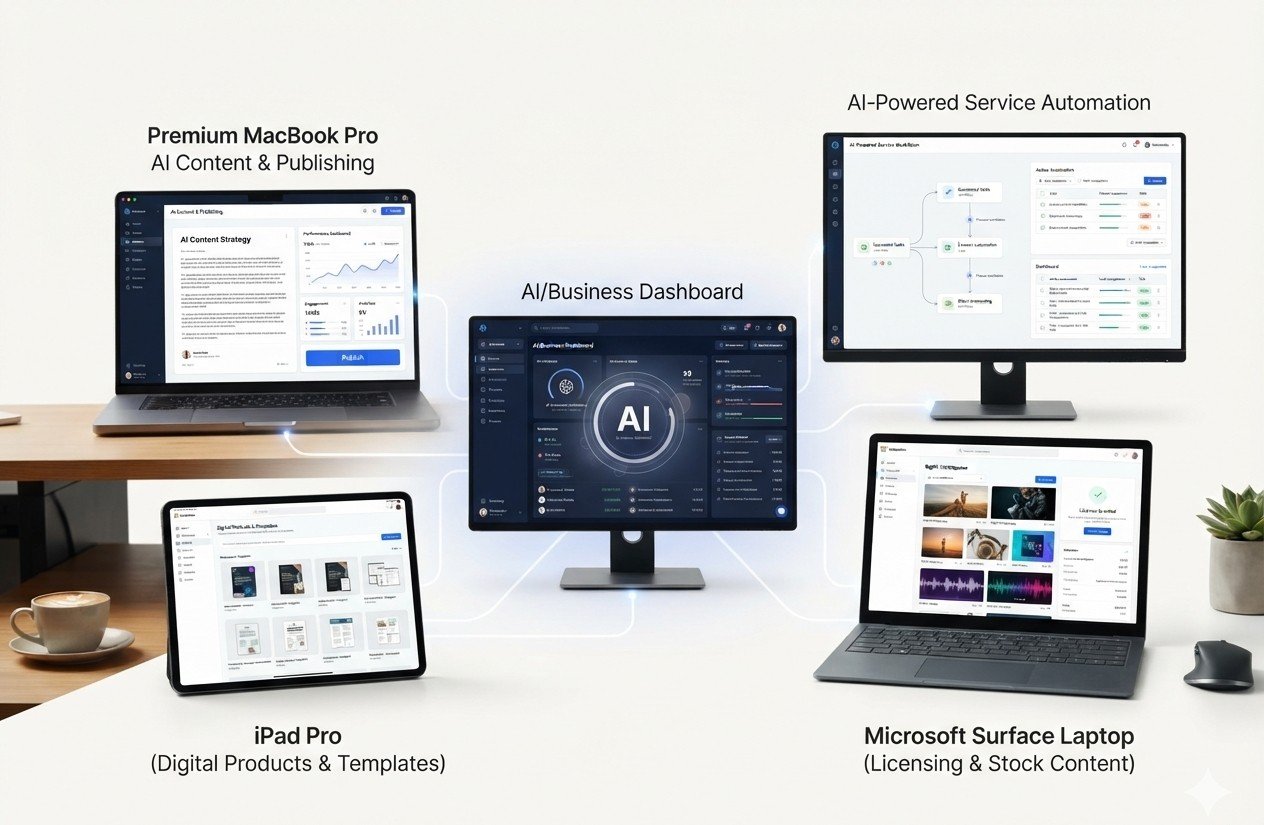
Before diving into each model, here is a side-by-side comparison to help you decide where to start. Pick one. Not three.
| Model | Startup Cost | Time to Launch | Passive Level | Difficulty | Best For |
|---|---|---|---|---|---|
| AI Content & Publishing | Low | 2–4 weeks | Medium | Medium | Writers, researchers |
| Digital Products & Templates | Low | 1–3 weeks | High | Medium | Creators, designers |
| AI-Powered Service Automation | Low–Medium | 2–6 weeks | Low–Medium | High | Freelancers, agencies |
| Licensing & Stock Content | Low | 2–8 weeks | High | Medium | Photographers, musicians |
How to read this table: “Passive Level” refers to how much ongoing attention the model needs once it is running. Digital products and licensing tend to be the most hands-off after launch. Service automation is the most hands-on but often the fastest to generate revenue.
Model One: AI-Assisted Content and Publishing
This covers blogs, niche newsletters, and digital books or guides. AI handles first-draft generation, outlining, and editing suggestions.
You handle fact-checking, personal insight, and the final read-through that keeps the content from sounding like everyone else’s.
Revenue here comes from three places. Display advertising once you have consistent traffic, affiliate commissions, and direct product sales like ebooks or templates.
A hypothetical example: a UK-based freelance writer builds a newsletter around home energy efficiency. They use AI to draft weekly research summaries and monetize through affiliate links and a paid tier with deeper cost-calculator templates. This is illustrative, not a documented case.
For a new content site, meaningful advertising revenue often requires substantial traffic. Affiliate sales or direct products may be more practical during the early stage.
Realistic first-year revenue for content projects varies enormously. From effectively nothing to a few hundred dollars a month for many people who stay consistent. A smaller number reach four figures monthly once an archive of 100+ pieces and some search ranking exists.
Model Two: Digital Products and Templates
Notion templates, spreadsheet tools, Canva design packs, and prompt libraries fall here. AI speeds up the build. Drafting the structure, writing instructional copy, generating example content.
But the product still needs to solve a specific, felt problem for someone. That part cannot be automated.
Platforms like Etsy, Gumroad, and Payhip are common distribution points. Etsy’s fee structure includes a $0.20 listing fee plus a 6.5% transaction fee in most markets. Payment processing is on top of that.
These numbers are worth checking directly on Etsy’s seller page since fee structures change.
Model Three: AI-Powered Service Automation
This is less “passive” and more “leveraged.” Using AI to handle client work faster so you can serve more clients per hour without proportionally increasing your hours.
Copywriting agencies, social media management, and basic virtual assistant work all fit this pattern.
The income is not passive in the traditional sense. But it scales differently once workflows are automated with tools that draft, schedule, and report with less manual input.
Model Four: Licensing and Stock Content
AI-assisted stock photography, music beds, and video b-roll can be licensed through marketplaces like Shutterstock, Adobe Stock, and Artlist.
It is worth checking each platform’s current policy on AI-assisted content specifically. Rules have shifted more than once and vary by platform.
Note the distinction between AI-assisted and fully AI-generated content. Most major stock platforms allow the former and restrict the latter.
Model Comparison by Time and Income
| Model | Setup Time | Maintenance | Revenue Potential | Passive Potential |
|---|---|---|---|---|
| AI Content | High | Medium | Medium–High | Medium |
| Digital Products | Medium | Low | Medium–High | High |
| Automation Services | Medium | High | High | Low |
| Licensing | Medium | Low | Medium | High |
How to Find a Profitable AI Passive Income Niche
The single most common reason AI side projects fail is not the tools. It is choosing a niche that is too broad or too crowded.
A good niche has four ingredients: specific audience + painful problem + existing demand + reachable customers.
| Too Broad | Specific Enough |
|---|---|
| “Make money with AI” | AI workflows for real estate agents |
| “Fitness templates” | Meal-planning spreadsheets for busy households managing specific dietary needs |
| “AI for small business” | Automated intake summaries for small veterinary clinics |
| “Study guides” | AI-assisted study guides for a specific nursing certification exam |
How to Research a Niche Before Committing
- Search Google autocomplete for your topic to see what real people type.
- Look at Etsy, Gumroad, or Amazon for existing products and read their reviews. Especially the negative ones.
- Search Reddit and niche forums for recurring questions.
- Check whether competitors have recent reviews. A market with no recent activity may be dead.
- Talk to three potential customers before building anything.
How to Build Passive Income with AI Tools Step by Step
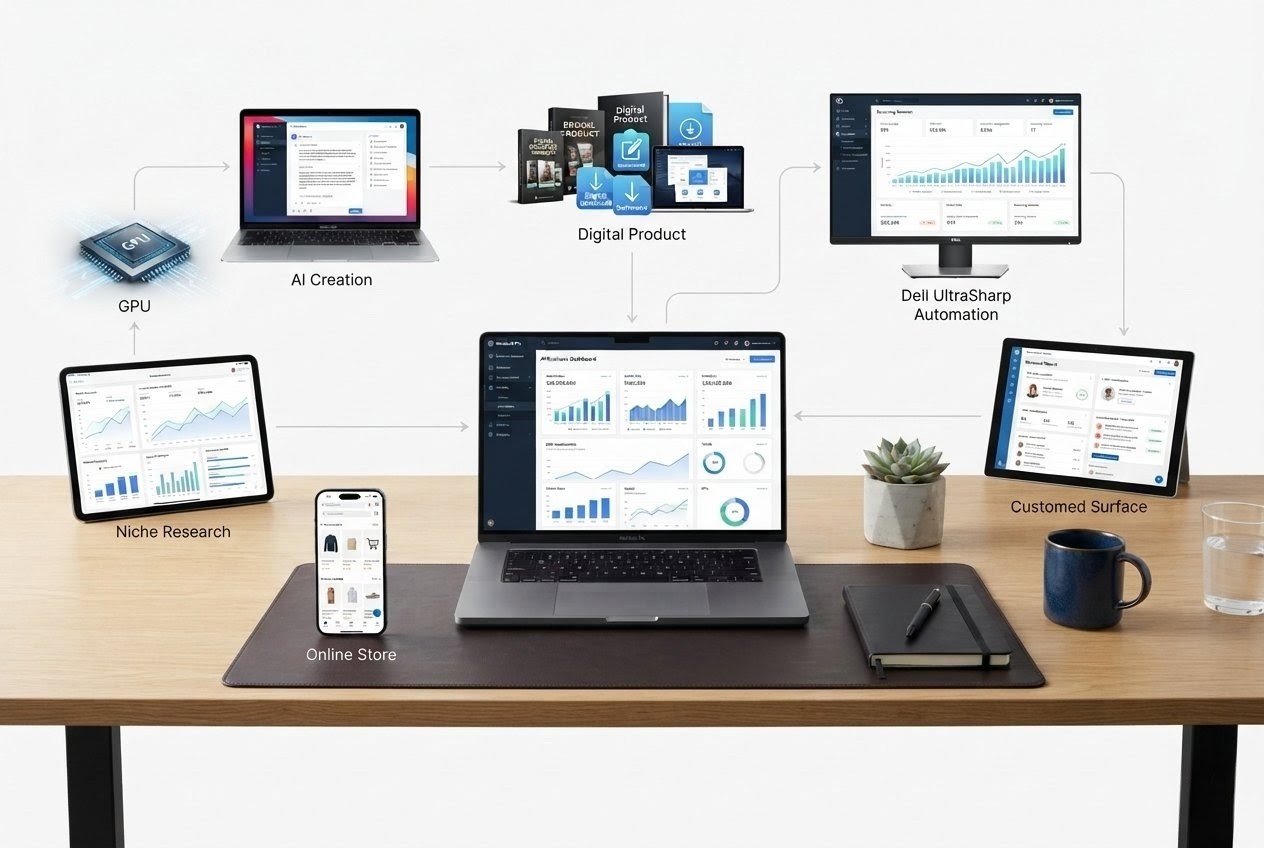
The article’s title is “How to Build.” So here is the actual build sequence, in order.
Choose a niche using the criteria above. Specific audience, painful problem, existing demand.
Identify a painful problem your audience already spends money or time trying to solve.
Choose one business model from the four above. Not two. One.
Validate demand before building. Search volume, competitor products, forum questions, or a simple waitlist.
Build the smallest product you can ship in under 20 hours of active work.
Add AI workflows for the repetitive parts. Drafting, outlining, formatting, scheduling.
Create a sales page that states clearly who the product is for and what problem it solves.
Set up payment processing and test it with a real transaction before launch.
Build distribution — one platform, one audience, one channel to start.
Automate repetitive tasks with tools like Zapier or Make once the manual version works.
Track revenue and costs in a simple spreadsheet from day one.
Improve based on data — not on what felt good to make.
How to Validate an AI Income Idea Before Spending Money
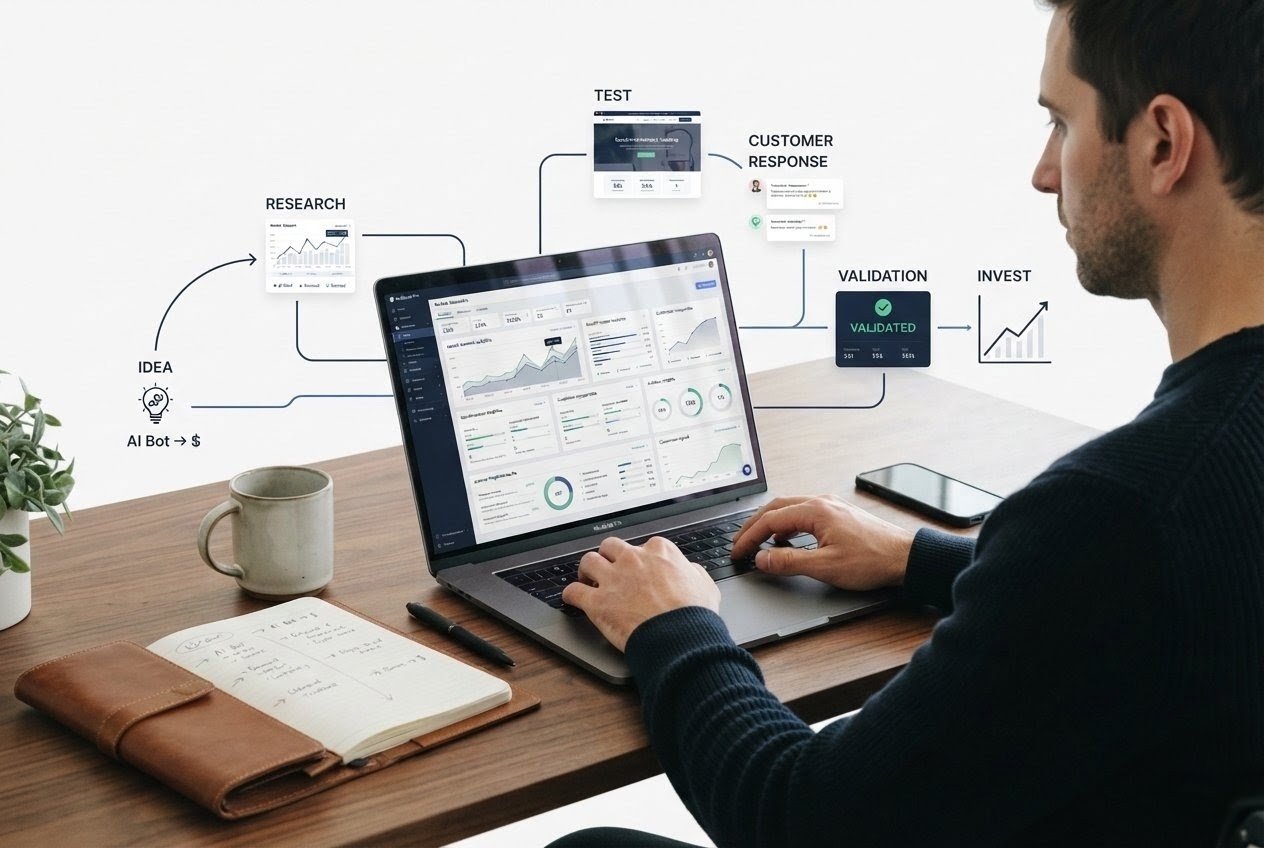
Validation is the step most people skip. It is also the cheapest one to do. Before you build anything, check these signals.
Validation Signals
- Search demand: does the topic have consistent search interest?
- Competitor products: are others already selling something similar, and are they still active?
- Existing reviews: what do buyers complain about in 1–2 star reviews?
- Reddit/forum questions: are people asking about this problem repeatedly?
- Marketplace evidence: does Etsy, Gumroad, or Amazon show active sales in this category?
- Google autocomplete: what related questions does Google suggest?
- Search results: who ranks on page one, and can you realistically compete?
- Customer interviews: talk to three people in your target audience.
- Pre-orders or waitlist: the strongest signal is someone willing to pay or sign up before the product exists.
If you cannot find evidence of demand through at least three of these, change the idea. Not the tools.
First Wins: What to Build in Your First 30 Days
Pick one model, not three. The biggest reason side projects stall is not lack of tools. It is spreading effort across too many untested ideas at once.
Choose the narrowest version of one idea. Ship something small within two weeks. See if anyone responds before building anything larger.
A workable first project is something you can complete in under 20 hours of active work. A single digital template, five newsletter issues, or one small automation for a friend’s business.
Small, finished, and tested beats large, half-built, and theoretical.
Global Tools You’ll Actually Need
| Task | Example Tools | Main Use |
|---|---|---|
| Research | ChatGPT, Claude | Research & outlining |
| Writing | ChatGPT, Claude | Drafting & editing |
| Design | Canva | Graphics & templates |
| Website | WordPress | Publishing & blog |
| Store | Gumroad, Payhip | Digital product sales |
| MailerLite, ConvertKit | Email marketing | |
| Automation | Zapier, Make | Workflow automation |
Resist the urge to buy every AI tool advertised to you. Most successful small operations run on three or four tools they know well, not fifteen they have each used twice.
Verify current pricing and availability before committing. Tool features and regional access change frequently.
Startup Cost: What You Actually Need to Spend
| Expense | Lean Setup | Standard Setup |
|---|---|---|
| AI tools | $20 | $60 |
| Website/store | $0–$20 | $30 |
| Email tool | $0 | $15 |
| Design | $0–$15 | $15–$30 |
| Automation | $0 | $20–$50 |
| Total (monthly) | $20–$55 | $140–$185 |
Most models in this guide can start under $200 for the first month, including a basic setup. Paid advertising is optional and best delayed until you have validated demand organically.
Scaling Without Losing Quality
The point where most AI-assisted businesses run into trouble is scaling output volume faster than quality control can keep up.
If one person is generating fifty pieces of content a week with AI assistance and reviewing none of them carefully, error rates climb. Audience trust erodes quietly before it erodes visibly.
A workable scaling rule: for every increase in AI-generated output volume, increase your review time proportionally. Or bring in a second person specifically for quality control before you add more volume.
International Expansion: What Actually Changes
Expanding a content or digital product business internationally is less about translation and more about payment infrastructure, tax registration thresholds, and platform availability.
A product that sells well to a US audience does not automatically translate to Germany or Japan without adjusting for local payment preferences, currency display, and VAT registration.
EU VAT rules for digital goods are complex and depend on factors including your business location, your customers’ location, and whether you sell through a marketplace. Different member states apply different thresholds, and the One Stop Shop scheme is one option among several.
This is general information, not tax advice. Verify your specific obligations with a qualified professional or official EU source before selling internationally.
Advanced Tactics for Year Two
Once a stream is earning consistently, the higher-leverage move is usually not adding a second stream. It is deepening the first one.
Building an email list from your existing audience. Testing a higher-priced tier. Licensing your content or template library to a second platform.
Diversifying too early, before one stream is stable, tends to dilute attention rather than multiply income.
What Actually Goes Wrong (Three Honest Admissions)
Mistake One
Publishing AI-drafted content without a real edit pass. Search engines and readers have both gotten better at recognizing generic, unedited AI text. It tends to underperform compared to content with a clear point of view layered on top.
Mistake Two
Underpricing digital products to compete on price rather than differentiation. A lower price rarely wins against an established competitor. A sharper angle for a specific audience usually does.
Mistake Three
Ignoring tax obligations until the first year-end. Freelance and side-business income is taxable in essentially every jurisdiction covered in this guide. The paperwork is far easier to handle with contemporaneous records than a reconstruction six months later.
Hidden Costs and Fees to Budget For
Beyond subscription costs, budget for chargebacks and refunds. These run higher for digital products than physical ones in most industries.
Currency conversion losses on international sales. The AI subscription creep that happens when you keep adding tools. And the accounting or bookkeeping cost once revenue is high enough to need it.
Simple spreadsheet tracking works fine at low revenue levels. Professional bookkeeping typically becomes worthwhile once income and complexity grow.
Competition and Time Investment, Realistically
The AI-assisted side income space is more crowded in 2026 than it was two years ago. That is worth saying plainly rather than glossing over.
Standing out now requires either a genuinely specific niche, a distribution advantage, or a level of polish that most competitors skip.
Expect five to fifteen hours a week for most models during the build phase. That drops to three to eight hours a week for maintenance once a system is running.
Even “passive” maintenance still means checking numbers, answering customer questions, and updating content periodically.
Your 90-Day Global Action Plan
| Period | Main Goal | Key Deliverable |
|---|---|---|
| Days 1–14 | Choose model & niche | Validated idea in one sentence |
| Days 15–30 | Build MVP | Smallest working version |
| Days 31–45 | Launch to first audience | First real feedback |
| Days 46–60 | Revise & register | Improved offer + legal setup |
| Days 61–75 | Expand distribution | Second platform or ad test |
| Days 76–90 | Review honestly | Double down or pivot |
Days 1 to 14: pick one model from this guide, research three competitors or comparable products in your target niche, and draft your core offer in one sentence.
Days 15 to 30: build the smallest working version — one template, five content pieces, or one automated workflow for a test client. Set up your payment processor and check its availability in your country.
Days 31 to 45: publish or launch to a small first audience — friends, a relevant online community, or an existing personal network. Collect honest feedback, including the negative kind.
Days 46 to 60: revise based on feedback, register for any required tax or business structure (an LLC in the US, a Ltd company in the UK, or the equivalent sole trader registration), and set up basic bookkeeping.
Days 61 to 75: expand distribution — a second platform, a small paid ad test with a strict budget cap, or outreach to a slightly larger audience segment.
Days 76 to 90: review your numbers honestly. If you have any paying customers or measurable traction, decide whether to double down on this model or adjust. If you have none, that is meaningful data too — reassess the niche before reassessing the tools.
Your Comprehensive Checklist
Before You Launch
- Business structure registered appropriately for your country (LLC/sole proprietorship in the US, Ltd/sole trader in the UK, equivalent structures elsewhere)
- Payment processor set up and tested with a real transaction
- Tax registration confirmed, including VAT/GST thresholds if selling internationally
- Data privacy basics covered if you collect emails or customer data
- At least one AI tool subscription matched to your specific workflow
- A tracking sheet for income, expenses, and hours worked, even a simple one
- A realistic 90-day check-in scheduled on your calendar, not left to memory
Regional Considerations
This section provides general information only and is not legal or tax advice. Rules vary by jurisdiction and change over time. Verify current requirements with official sources or a qualified professional.
Sole proprietorship is the simplest starting structure. An LLC adds liability protection and is worth considering once revenue is consistent. Self-employment tax and quarterly estimated payments to the IRS apply once income crosses relatively modest thresholds.
Registering as a sole trader with HMRC is straightforward and free. A limited company offers different tax treatment worth discussing with an accountant once income grows. The Self Assessment deadline and Making Tax Digital requirements are worth building into your calendar early.
Data-protection rules may apply to businesses handling EU residents’ data depending on specific circumstances. VAT registration for digital goods depends on sales thresholds, seller location, and whether you sell through a marketplace. Rules differ meaningfully between member states.
Payment infrastructure varies significantly. Stripe’s availability differs by country, and platforms like Payoneer often fill the gap for freelancers in markets with less mature payment processing. Manufacturing and supply chain-adjacent digital services have a genuine opening here.
Several free zones (in the UAE, for instance) offer simplified business registration for online and digital businesses. The specific benefits depend on the zone and are worth verifying directly with the relevant authority rather than relying on secondhand summaries.
Mobile payment infrastructure (M-Pesa and similar systems) is often more relevant than card-based payment processors depending on the country. Digital transformation initiatives have created openings in AI-assisted training content and small business automation. Africa is not a single market — payment and tax systems vary widely by country.
Starting an AI Side Income Business from Pakistan

For readers in Pakistan, a few practical considerations differ from the US/UK/EU context.
Stripe is not directly available for Pakistani businesses. Freelancers and sellers often rely on Payoneer, Wise (where available), or local bank transfers for international clients.
- Freelancing platforms: Upwork, Fiverr, and similar platforms are widely used, with withdrawals typically routed through Payoneer or local bank channels.
- Digital products: selling through Gumroad or Payhip is possible, but payout methods and currency conversion need checking before launch.
- Tax record keeping: maintaining clean income records is advisable regardless of current thresholds, since rules and enforcement change.
- Local vs international customers: local clients may pay via bank transfer or mobile wallets, while international clients require a different payment setup entirely.
Regulations and platform availability change frequently. Verify current requirements with official sources before making business decisions.
Frequently Asked Questions
Yes, but “passive” means less ongoing effort than a traditional job, not zero effort. Most people who succeed spend real hours upfront and moderate hours on maintenance.
Digital products and templates tend to have the lowest barrier. Low startup cost, fast launch time, and relatively high passive potential once built. Content and licensing take longer to gain traction. Service automation requires more ongoing client work.
You can start with very little. Many tools have free tiers, and platforms like Gumroad do not charge upfront. But you will still need time, and most people spend $20–$50 a month once they commit to a tool stack.
Prompt writing, basic editing of AI output, and one automation tool (Zapier or Make) cover most early needs. Specialized skills can wait until you have identified a specific bottleneck.
Yes, but platform policies vary. Some marketplaces restrict fully AI-generated content, and disclosure requirements are increasing in several jurisdictions. Check each platform’s current policy before publishing.
A common approach is to reinvest 20–30% into better tools, advertising tests, or outsourcing the tasks you are slowest at. Keep the rest as actual income.
Most models in this guide can start with under $200. That covers one AI subscription, a basic website or storefront tool, and a payment processor. Paid advertising is optional and best delayed until you have validated demand organically.
Start with one general-purpose assistant for writing and research. Add specialized tools only once you have identified a specific bottleneck it solves.
Registering your income appropriately and following applicable data-privacy rules is the baseline expectation in most jurisdictions. Specific forms and thresholds differ by country, which is why the regional section above matters — and why this guide is general information, not legal or tax advice.
Most realistic timelines run three to nine months for a first meaningful stream of income. Continued growth over twelve to twenty-four months for those who stay consistent.
Increasingly, yes, in some contexts. Several platforms and some jurisdictions have introduced disclosure requirements for AI-generated content. Transparency with your audience tends to build more trust than it costs you.
Closing Thoughts
None of the models for how to build passive income with AI tools are shortcuts. If anything in the wider AI income conversation sounds like one, that is usually the tell to look closer rather than move faster.
What AI genuinely offers here is a lower cost of experimentation. You can test a content idea, a digital product, or a small service offer in weeks instead of months, and find out early whether it has real demand behind it.
The businesses that hold up past the first few months share a pattern. A specific audience, a real edit and review process layered on top of AI output, and an owner who treats the numbers honestly rather than chasing whichever tactic trended this week.
Regional rules will shape some of your setup decisions. They do not change that core pattern.
If you are weighing where to start, the narrower option is usually the better one. One product, one audience, one platform, tested properly before you add a second.
For a related income model, see our guide on how to make money selling digital products in 2026.
- Why AI Has Actually Changed This Space
- The Market Opportunity, Honestly Assessed
- Which AI Passive Income Model Is Best?
- Model One: AI-Assisted Content
- Model Two: Digital Products
- Model Three: Service Automation
- Model Four: Licensing & Stock Content
- Model Comparison by Time and Income
- How to Find a Profitable Niche
- How to Build an AI System Step by Step
- How to Validate an Idea
- First Wins: What to Build in 30 Days
- Global Tools You’ll Actually Need
- Startup Cost: What You Need to Spend
- Scaling Without Losing Quality
- International Expansion
- Advanced Tactics for Year Two
- What Actually Goes Wrong
- Hidden Costs and Fees
- Competition and Time Investment
- Your 90-Day Global Action Plan
- Your Comprehensive Checklist
- Regional Considerations
- Starting from Pakistan
- Frequently Asked Questions
- Closing Thoughts
Join the Discussion
1 comment
Share a question, a tip or what worked for you. Please keep it helpful and on topic.
No comments yet. Be the first to share your thoughts.