

KEY TAKEAWAYS
- Digital products let you sell the same item repeatedly without inventory or shipping.
- Most beginners start with one product, one platform, and a small audience.
- Meaningful income typically takes three to twelve months of consistent effort.
- Platform fees, taxes, and marketing time are the hidden costs most people miss.
- This guide covers the full path from first product to international scaling.
Learning how to make money selling digital products in 2026 starts with one honest idea: you build something once, and you sell it a thousand times. That sounds almost too simple, which is exactly why so many people approach it with skepticism.
The idea of digital products has been oversold by marketers promising six-figure months from a single ebook. The backlash against that hype is understandable.
What is less discussed is the quieter, more realistic version of this business model. A designer selling Notion templates on the side. A teacher packaging lesson plans for other teachers. A photographer licensing presets to hobbyists.
The infrastructure for selling digital products has matured. A single person with a laptop can now compete on quality, if not always on marketing budget, with much larger operations.
This guide walks through what digital products actually are, how to choose one worth building, where to sell it, and what the first year realistically looks like.
By the end, you should have a clear sense of whether this path fits your situation. And if it does, a concrete plan for how to make money selling digital products over the next ninety days.
Read This Before You Start
Most people who try to sell digital products do not fail because the idea is bad. They fail because they underestimate the timeline.
Realistic timeline: expect very little income in your first thirty days. Months two through four are about finding what connects with buyers.
Costs you will actually pay: platform fees (commonly 5% to 10% per sale), payment processing (around 2.9% plus a fixed fee), and tool subscriptions.
Privacy matters: if you collect customer emails, you are responsible for handling that data properly under GDPR or CCPA.
Tax obligations differ significantly by country. This guide cannot substitute for advice from a local accountant.
None of this is a warning to stop. It is a warning that “getting started” and “getting paid reliably” are two different phases.
What Counts as a Digital Product
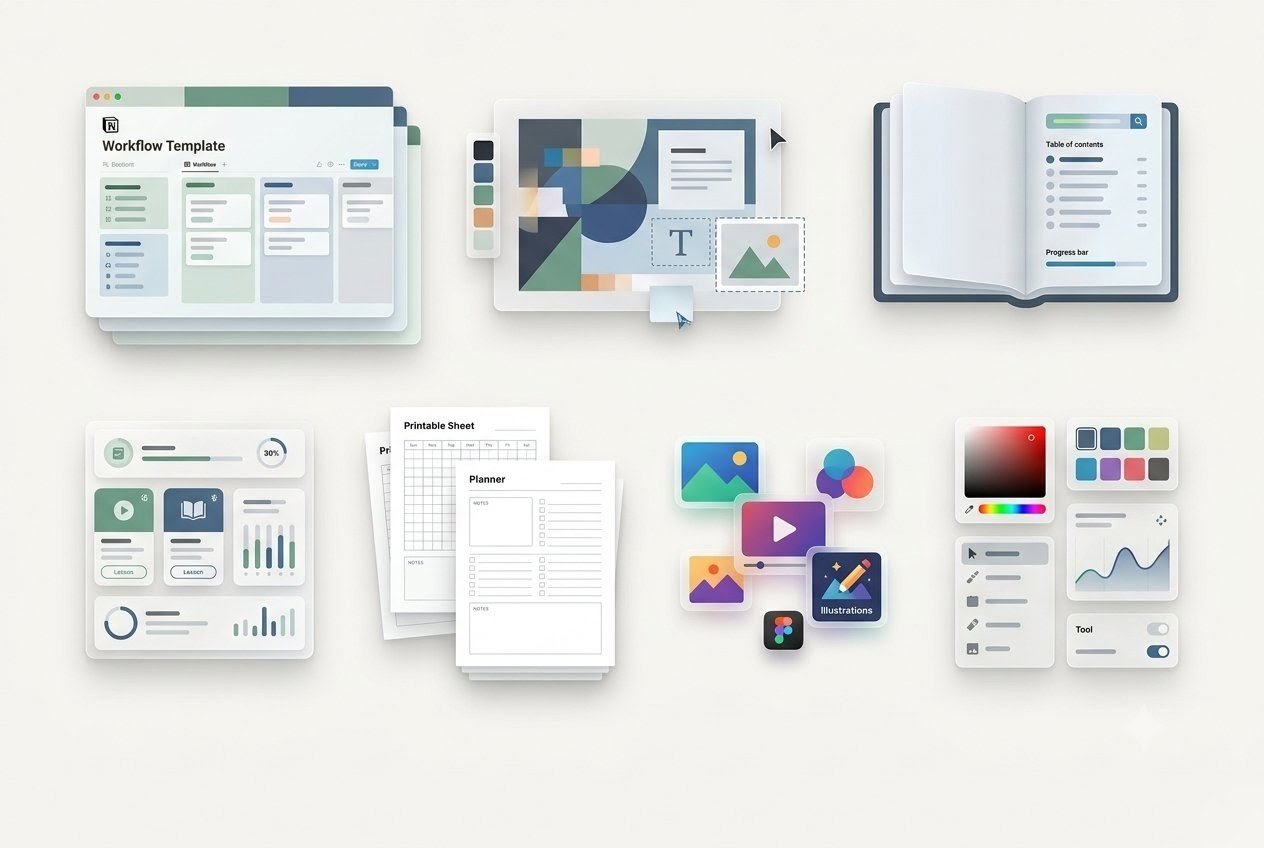
The category is broader than most beginners realize. Templates, courses, ebooks, stock assets, software tools, and printables all qualify.
Templates (Notion, Canva, spreadsheet, resume) are the most accessible entry point. They require design skill rather than deep technical knowledge.
Online courses work well for people with an established skill they can teach step by step. Ebooks remain popular in niche topics where a shorter resource beats a generic 300-page book.
Stock assets (photos, fonts, sound effects, video clips) serve other creators who need raw material. AI prompt packs have grown quickly since generative AI tools became mainstream.
Printables (planners, worksheets, wall art) remain a strong entry point on marketplaces like Etsy. Buyers already trust the platform to curate quality.
The common thread: you build it once, and each additional sale costs you close to nothing beyond payment processing fees.
| Product Type | Best For | Difficulty | Example |
|---|---|---|---|
| Templates | Designers/creators | Low | Notion, Canva |
| Ebooks | Writers/experts | Low–Medium | Guides |
| Courses | Teachers/experts | Medium | Video course |
| Printables | Designers | Low | Planners |
| Software | Developers | High | SaaS/tool |
| Stock Assets | Photographers/artists | Low–Medium | Photos, fonts |
| AI Prompt Packs | AI-savvy creators | Low | Profession-specific prompts |
Digital Product Ideas You Can Sell in 2026
The following list is not exhaustive. It covers the categories where beginners have the most realistic path to a first sale.
For each idea, the buyer and the problem matter more than the format itself.
| Product Idea | Target Buyer | Problem It Solves | Complexity |
|---|---|---|---|
| Notion templates | Freelancers, small teams | Disorganized workflows | Low |
| Canva templates | Social media managers | Need for professional visuals | Low |
| Spreadsheet templates | Bookkeepers, small business owners | Manual tracking, calculation errors | Low–Medium |
| AI prompt packs | Real estate agents, recruiters | Inconsistent AI output | Low |
| Ebooks and guides | Hobbyists, professionals | Lack of specific information | Low–Medium |
| Checklists | Project managers | Forgotten steps | Low |
| Printable planners | Students, professionals | Time management | Low |
| Social media templates | Influencers, small brands | Consistent posting | Low |
| Resume/CV templates | Job seekers | Standing out in ATS systems | Low |
| Educational worksheets | Teachers, parents | Saving lesson prep time | Low–Medium |
| Stock assets | Other creators | Need for raw material | Low–Medium |
| Presets | Photographers, hobbyists | Consistent editing style | Low |
| Mini-courses | Skill-seekers, beginners | Structured learning | Medium |
| Digital toolkits | Entrepreneurs, freelancers | All-in-one resources | Medium |
| Software/micro-SaaS | Businesses, professionals | Automating repetitive tasks | High |
The pattern across all of these: the product solves a problem for a buyer who can be described in one sentence. If you cannot name the buyer and the problem, the idea is not ready.
How to Choose a Product That Actually Sells
If you want to know how to make money selling digital products, start by studying what already exists in your chosen niche. The single biggest mistake beginners make is building something they personally find interesting. Not something a specific group of people is actively trying to solve.
A useful filter: can you name twenty real people who would want this? If you cannot picture the buyer, you are guessing.
Look at your own work history, hobbies, and frustrations first. A bookkeeper who built an expense-tracking spreadsheet for her own clients already has a validated product.
A teacher who spent years making worksheets for her classroom has years of proof that the format works.
Validate before you build the full version. Post a rough outline in a relevant community and ask if people would want it. Pre-sell a small batch at a discount before the product is finished.
Search existing marketplaces for similar products. Read the negative reviews closely. They tell you exactly what is missing from what already exists.
A common early mistake is spending three or four months perfecting a product before showing it to a single potential buyer. By the time it launches, the creator has no idea if the market wants it.
Validating in week one, even roughly, saves months later.
How to Validate Your Digital Product Idea

Validation is not a single step. It is a short, repeatable process that happens before you build the full product.
The goal is to gather evidence that a specific group of people will pay for the solution you are considering.
Start by describing your buyer in one sentence: “A freelance graphic designer who struggles to track multiple client projects.”
If you cannot write that sentence, the idea is too vague to validate.
Next, identify where that buyer already gathers online. A subreddit, a Facebook group, a LinkedIn niche, a Discord server.
Post a rough outline and ask directly: “Would this solve a problem for you?” The responses are data, not rejection.
Pre-selling. Offer the product at a discount before it is finished, with a clear delivery date. If five people pay, you have both validation and early revenue. If nobody pays, you have saved yourself weeks of work.
A third method is reviewing existing marketplace listings. Read the negative reviews of competing products carefully.
They almost always reveal exactly what buyers wish existed. That gap is your opportunity.
Validation does not need to be statistically rigorous. Ten real conversations with potential buyers will teach you more than any amount of guessing.
How to Create Your First Digital Product
Perfectionism kills more digital products than bad ideas do. Build the smallest version that solves the core problem completely.
Canva, Notion, and Google Slides cover most template and worksheet creation needs without requiring design software licenses.
For courses, a phone camera and a quiet room beat expensive equipment you have not learned to use yet.
AI tools have genuinely changed the production side of this business. Drafting outlines and generating first-pass copy now happen in a fraction of the time.
That said, buyers can usually tell when a product is unedited AI output. The products that sell well use AI to speed up production, then have a real person review and refine the result.
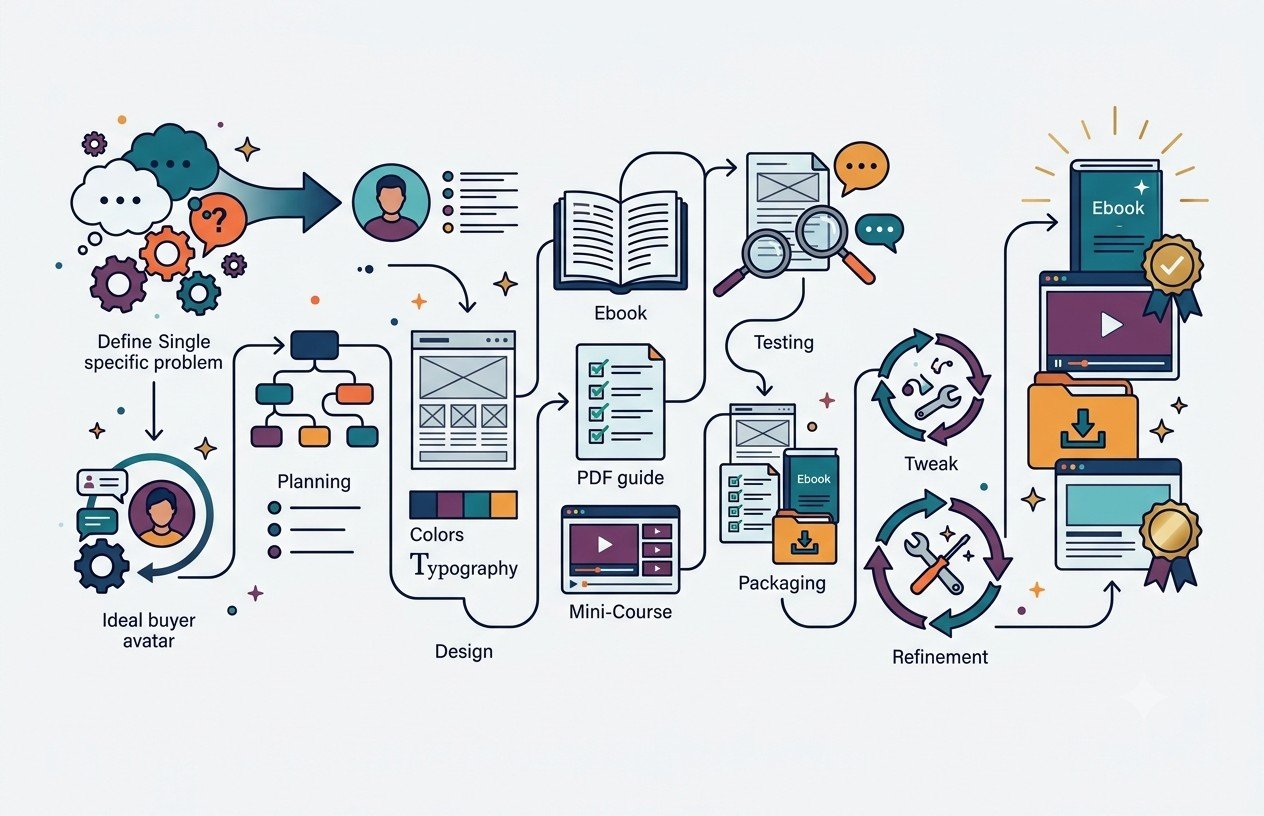
Choose one problem. Pick a single, specific problem your buyer has. Not “productivity” but “tracking freelance client hours.”
Define the buyer. Write one sentence describing who will pay for this. If you cannot, return to validation.
Decide the product format. Template, ebook, checklist, mini-course, or toolkit. Choose the format that delivers the solution most directly.
Create the minimum version. Build the smallest complete version that solves the core problem. Leave secondary features for version two.
Test it with real users. Give it to three to five people who match your buyer profile. Ask what confused them.
Package the files. Organize everything clearly. A messy file structure makes even a good product feel cheap.
Create previews and mockups. Buyers cannot touch a digital product. Show them what it looks like inside.
Write the product description. Focus on the problem solved, not the features included. “This tracker saves you three hours per month” beats “Includes 12 tabs.”
Upload and publish. Set the price, write the listing, and make it available. Launch before it feels perfect.
Collect feedback and update. The first ten buyers will tell you what to fix. Update the product and note the improvements.
This process can be completed in two to four weeks for a simple product. The goal is a complete, useful product that a specific buyer will pay for.
Where to Sell: Platforms Compared

There is no single correct platform. The right choice depends on your product type and whether you already have an audience.
| Platform | Best for | Typical fee structure | Built-in audience |
|---|---|---|---|
| Etsy | Printables, templates | Listing fee plus ~6.5% transaction fee | Strong |
| Gumroad | Ebooks, courses, software | ~10% plus payment processing | Weak |
| Payhip | Similar to Gumroad, EU-VAT built in | ~5% plus processing | Weak |
| Shopify | Full branded store | Monthly subscription plus processing | None |
| Teachable/Kajabi | Structured online courses | Monthly subscription | None |
| Your own site + email list | Maximum control and margin | Hosting plus payment processor fee | None |
The percentages shown above are approximate and subject to change. Before publishing your listing, verify the current fee structure on the platform’s official pricing page.
Marketplaces like Etsy trade a chunk of your margin for built-in buyer traffic. That matters enormously if you have no audience yet.
Standalone tools like Gumroad or Payhip keep more of each sale but require you to bring your own visitors.
Many sellers who reach a meaningful income level run two channels at once: a marketplace for discovery and their own site for repeat customers.
How to Price Your Digital Product
Underpricing is more common than overpricing among beginners. Mostly out of fear that nobody will pay more.
Low-priced products (under $15) require high sales volume to add up to meaningful income.
Mid-priced products ($30–$150) can produce real income with a much smaller number of buyers, provided the perceived value matches the price.
Course and coaching-adjacent products often price higher still. They reflect the time investment buyers expect to save.
A practical starting method: price at what feels slightly uncomfortable to charge, then adjust based on actual buyer response rather than guesswork.
If conversion is strong and refund requests are low, you likely have room to raise the price on your next batch of customers.
How Much Can You Make Selling Digital Products?
How much can you make selling digital products? This is the question most beginners actually want answered. It deserves its own section rather than being buried in a FAQ.
The honest answer: revenue depends on three variables. Price, conversion rate, and traffic.
The following examples illustrate the arithmetic. They are not projections or promises.
According to Statista, the global digital products market continues to grow year over year.
| Price | Sales per Month | Monthly Revenue |
|---|---|---|
| $10 | 10 | $100 |
| $25 | 20 | $500 |
| $50 | 50 | $2,500 |
| $100 | 50 | $5,000 |
These figures represent revenue, not profit. Platform fees, payment processing, refunds, and software subscriptions must be subtracted.
A $2,500 month at a 10% platform fee and 3% processing fee is closer to $2,175 before accounting for tools and taxes.
The purpose of this section is not to suggest that $5,000 months are typical. They are not.
The purpose is to show that the path to meaningful income is arithmetic, not magic.
What matters most is that you track your own numbers from the first sale. Your conversion rate, average order value, and refund rate tell you what to do next.
First Wins: Getting Your First Ten Sales
The first ten sales matter disproportionately. Both for morale and for gathering real feedback.
Most successful beginners get there through one of three routes.
Route one: posting genuinely useful free content in a community where their buyers already gather.
Route two: reaching out directly to ten to twenty people who match their target buyer and offering the product at a discount.
Route three: leveraging an existing small audience built around a related topic.
Paid ads are usually not the right first move. Without proven messaging, ad spend tends to disappear without teaching you much.
Organic outreach is slower but far cheaper. The direct conversations you have with early buyers often reveal exactly what to fix next.
Marketing Without a Budget
Content built around your buyer’s specific problem outperforms generic promotional posts by a wide margin.
A template seller doing well on social media is not posting “buy my template.” They are posting the problem the template solves.
Short-form video has become one of the most accessible discovery channels for visual products. The format rewards showing the product in use.
Email remains one of the highest-converting channels available. Largely because you own the list.
Unlike a social platform, nobody can change the algorithm and cut your reach overnight.
Search-based discovery works well for products tied to specific, searchable problems. “Budget spreadsheet template” beats a clever brand name in the early months.
Distribution Channels at a Glance
- Google Search: Best for products tied to specific, searchable problems.
- Pinterest: Best for visual products like printables and templates.
- YouTube: Best for courses, tutorials, and products that benefit from demonstration.
- TikTok: Best for visual products and quick demonstrations.
- Instagram: Best for templates, presets, and lifestyle-adjacent products.
- LinkedIn: Best for professional products and B2B toolkits.
- Etsy Search: Best for printables and templates. A primary discovery channel.
- Email: Best for repeat buyers and higher-margin products.
- Communities: Best for validation and first sales. Requires genuine participation.
Hidden Costs and Fees to Budget For
Payment processing fees apply to every sale regardless of platform. Typically 2.9% plus a small fixed fee per transaction for card payments.
Marketplace fees range from roughly 5% to 10% depending on the platform and plan tier.
Currency conversion fees apply when payouts convert from the buyer’s currency to your bank’s currency. These vary by bank and payout service.
Software subscriptions commonly run $20 to $100 per month combined once a seller has more than one active tool.
Refunds and chargebacks are a real cost too. Budgeting for a small percentage of sales to be refunded is more realistic than assuming zero.
Selling Digital Products Internationally

A UK-based template creator and a Malaysia-based course creator face genuinely different obstacles. But the core questions are the same.
Can international buyers pay easily? And does the product make sense outside its country of origin?
Currency display matters more than sellers expect. Platforms like Shopify and Payhip can auto-detect a buyer’s location and show local currency. For payouts, services like Wise and Payoneer often offer lower conversion fees than traditional banks.
Language localization does not need to be a full translation on day one. Even a few key phrases or an adapted FAQ section signals that the product was built with that buyer in mind.
VAT on digital products sold to EU consumers is generally required once certain thresholds are met. The One Stop Shop system simplifies reporting across multiple EU countries. GDPR governs how customer data must be handled.
For current VAT rules, see the official European Union portal.
Income from selling digital products generally needs to be reported through Self Assessment once it exceeds the trading allowance threshold. The UK has its own VAT rules post-Brexit, separate from the EU’s.
Sole proprietorships are the simplest starting structure. Sellers in the US generally do not need to worry about VAT unless registered abroad, but should track state sales tax obligations.
Business registration requirements for online income vary considerably by country. Payment platform availability also varies. Confirm payouts before building a product.
Free zone business setups in hubs like Dubai offer streamlined registration for digital and online businesses, often with tax advantages. Setup costs differ by free zone.
Digital payment infrastructure has expanded quickly across many African markets. Mobile money platforms often work alongside or instead of traditional card payments.
Scaling Past Your First Product
Once one product proves it sells, the highest-leverage move is usually building a second product for the same buyer.
Not chasing an entirely new audience. A buyer who purchased a budgeting spreadsheet is a warm prospect for a debt payoff tracker.
This is where a small email list starts paying for the time it took to build.
Bundling is another underused lever. Packaging three related products together at a modest discount often increases average order value more than any single new product would.
Licensing deals can create a second revenue stream from work you have already built. Particularly for stock assets and templates.
Common Mistakes That Cost People Months
Building the entire product before validating demand is the most expensive mistake in terms of wasted time.
Months spent perfecting something nobody asked for.
Choosing a saturated category without a specific angle makes it far harder to stand out, even with good execution.
Ignoring the platform’s own search and discovery mechanics quietly caps how many people ever see the listing at all.
Using vague titles and tags instead of the specific phrases buyers actually search is a silent killer.
These are not rare missteps. They show up across nearly every seller community. Naming them plainly is more useful than pretending they do not happen.
For a related angle, see our guide on 10 real ways to make money with ChatGPT in 2026.
Your 90-Day Global Action Plan
Days 1–14: Pick your niche and validate. Choose a specific buyer group based on your own experience. Post in two or three relevant communities and ask directly whether people would use it.
Days 15–30: Build a minimum viable version. Create the smallest complete version of the product. Set up a seller account on your chosen platform and write a listing description focused on the problem solved.
Days 31–45: Launch to a small group first. Offer the product to people who responded during validation, ideally at a discount in exchange for a review.
Days 46–60: Open to the public and start content. Publish the listing publicly. Post two to three pieces of content per week showing the problem your product solves.
Days 61–75: Review the data and adjust. Look at which content drove the most interest and double down. Revisit pricing if conversion is strong or weak.
Days 76–90: Plan for the next quarter. Set a realistic income target based on actual data. Decide whether to invest in a second product or double down on marketing the first.
Your Comprehensive Checklist
Before You Launch
- Chosen a specific buyer group you can describe in one sentence
- Validated demand with real people before building the full product
- Selected a platform that fits your product type and audience size
- Built a minimum viable version rather than waiting for perfection
- Set a price based on perceived value, not fear of rejection
- Written a listing description focused on the problem solved
- Started an email list, even with a handful of subscribers
- Understood the fee structure of your chosen platform in full
- Checked whether VAT, sales tax, or other regional rules apply to you
- Set aside funds or a plan for taxes on any income earned
- Planned your first two weeks of content or outreach
- Reviewed at least five competing listings and their reviews
Region-Specific Additions
- US sellers: confirm sole proprietor vs LLC, understand self-employment tax.
- UK sellers: check Self Assessment registration with HMRC.
- EU sellers: understand VAT MOSS or One Stop Shop rules.
- Asia-Pacific sellers: research business registration requirements.
- Middle East sellers: confirm free zone or local registration requirements.
- Africa sellers: verify payout support and mobile money integration.
Frequently Asked Questions
This varies enormously by product, niche, and effort. Any guide claiming a guaranteed number should be treated with caution. A reasonable range for consistent part-time effort is a modest supplemental income by month six.
It depends on your country and how much you expect to earn. Many people start as a sole trader and formalize later once income becomes consistent. A local accountant can confirm the specific threshold.
There is no universal answer. Etsy suits visual, searchable products because of its built-in buyer traffic. Gumroad or Payhip suit sellers who already have some audience and want to keep more of each sale.
Yes. Many successful template and printable sellers rely entirely on product mockups, written content, and platform search. Video accelerates audience building, but it is not required for every category.
Most major platforms handle currency conversion and international payments automatically. For payouts to your own bank account, services like Wise often offer lower conversion fees than traditional banks.
It happens, and no platform fully prevents it. Watermarking previews, using platforms with some file protection, and including clear licensing terms reduce the frequency. Most sellers treat a small amount of piracy as a cost of doing business.
Three Insights Most Guides Leave Out
First, the platform you choose changes your marketing job more than it changes your product. A marketplace seller’s real job is optimizing for that platform’s internal search. A standalone-site seller’s real job is building traffic from outside sources entirely.
Confusing the two wastes the most time.
Second, your second product is usually far more profitable than your first. Because it sells to people who already trust you. Most guides focus entirely on the first product and treat everything after as an afterthought.
The compounding value actually starts there.
Third, refund and support requests are a data source, not just an annoyance. The specific wording people use when asking for a refund almost always points directly at what the next version should be.
Conclusion
Selling digital products is not a shortcut around building a real business. It is a genuinely lower-overhead way to build one.
The tools available in 2026 have lowered the barrier to starting. But they have not removed the need for a specific buyer, a real problem, and the patience to improve based on what people actually say.
Whatever product you choose to build first, the path forward is the same.
Validate before you build. Launch before it is perfect. Let real buyer feedback, not guesswork, decide what comes next.
- What Counts as a Digital Product
- Digital Product Ideas for 2026
- How to Choose a Product
- How to Validate Your Idea
- How to Create Your First Product
- Where to Sell: Platforms Compared
- How to Price Your Product
- How Much Can You Make
- Getting Your First Ten Sales
- Marketing Without a Budget
- Hidden Costs and Fees
- Selling Internationally
- Scaling Past Your First Product
- Common Mistakes
- Your 90-Day Action Plan
- Your Comprehensive Checklist
- Frequently Asked Questions
- Three Insights Most Guides Leave Out
- Conclusion
Join the Discussion
1 comment
Share a question, a tip or what worked for you. Please keep it helpful and on topic.
No comments yet. Be the first to share your thoughts.