


Key Takeaways
- Direct client acquisition is a placement problem, not a skills problem. Most freelancers can do the work; they just haven’t found the people with budgets.
- A high-paying client pays two to three times what bidding-site buyers in your niche typically offer, pays on time, respects scope, and has budget authority.
- Platforms cap your income because they reward volume and low prices, charge service fees, and keep your reputation inside someone else’s walled garden.
- A narrow, specific offer beats a general one. Specialists get referred because people can describe them in one sentence.
- Direct outreach is slow to pay off. A realistic goal for most people starting from a small network is one to three direct clients within three to five months.
- LinkedIn, targeted cold email, referrals, partnerships, content, communities, and agency subcontracting are the core channels.
- Payment friction, tax rules, and data-protection laws vary by region. Check the rules for each country you target.
- The freelancers who build durable pipelines are the ones who kept sending, posting, and following up through the dull stretch.
Finding high-paying freelance clients is not a skills problem for most freelancers. It is a placement problem.
If you’ve spent time on a bidding platform, you know the pattern. You write a careful proposal, you compete against forty other applicants, and the winner is often whoever quotes lowest. Platform fees come out of your earnings, the client relationship belongs partly to the marketplace, and a single bad review can sting for months.
It works for getting started. It rarely works for getting paid well.
Meanwhile, many businesses with larger or more specialized budgets also hire through referrals, professional networks, LinkedIn, search, events, agencies, and direct relationships—not only freelance marketplaces. A marketing director in Chicago, a founder in Manchester, an operations lead in Singapore, a clinic owner in Dubai: they all want a reliable specialist, and they’d rather hire someone recommended than someone ranked.
That’s the gap this guide is built around. At AiMoneyGuideCo, our focus is practical, AI-assisted income strategies that hold up outside the hype, and finding clients directly is one of the most durable skills a freelancer can build. It’s also one of the slowest to pay off, and we’ll be straight about that.
Here’s what to expect. By the end you’ll know who to target, what to say, how to price, and how to structure the first 90 days.
Will you land a $10,000 client in week three? Almost certainly not. A realistic goal for most people starting from a small network is one to three direct clients within three to five months, with income rising from there.
We’ll show the numbers behind that estimate and where they’re soft. Treat these timelines and figures as planning assumptions, not guarantees.
READ THIS BEFORE YOU START
Direct client acquisition isn’t a shortcut. Here’s the honest picture.
Timeline: Most freelancers who start from zero direct contacts need roughly 60 to 120 days before the first paid project from outreach or content. Referral-heavy businesses take longer to build but cost less to maintain.
These are practitioner estimates, not guarantees, and results vary by niche, skill level, and market.
Costs: You can start for under $100 a month using LinkedIn’s free tier, a basic email address on your own domain, and a simple one-page site. Adding LinkedIn Premium or Sales Navigator (pricing varies by plan and region; check current official rates), an email-sending tool ($30 to $100 a month), and a CRM (free to $50) brings a realistic serious setup to about $100 to $300 monthly. Prices change, so verify on each vendor’s site.
Privacy and data protection: Contacting business prospects is legal in many places but regulated. In the EU and UK, GDPR and the UK’s PECR rules apply; the US has CAN-SPAM; Canada has CASL. Collecting names and emails means you’re processing personal data. Keep records small, honour opt-outs immediately, and never buy scraped lists.
Tax and legal: You’re responsible for registering as self-employed or setting up a company, collecting VAT or GST where required, and filing returns. This article offers general information, not legal or tax advice. Speak to a qualified accountant in your country.
Currency and payments: International clients often want to pay in their home currency. Exchange-rate margins, conversion fees, receiving fees, and bank charges can reduce what you actually keep. We cover this later.
What this guide doesn’t promise: A fixed income, instant clients, or a script that works for everyone. Anyone offering those is selling something.
WHAT “HIGH-PAYING” MEANS IN 2026

High-paying is relative. A $75 per hour rate is excellent in some markets and ordinary in others. The better yardstick is project value compared with the value you create for the client.
As a working definition, a high-paying client is one who pays at least two to three times what bidding-site buyers in your niche typically offer, pays on time, respects scope, and has budget authority.
For a writer that might mean $2,500 per case study instead of $150 per article. For a web developer, $8,000 for a booking system rather than $500 for a template tweak. For an AI automation consultant, a monthly retainer of $3,000 to $6,000.
Those figures are illustrative ranges seen across public freelancer pricing surveys and practitioner writing, not benchmarks you can count on. Your own market research will tell you more than any average. High-paying is about price, client quality, scope, payment reliability, and business value—not just the dollar amount.
WHY PLATFORMS CAP YOUR INCOME

Freelance platforms limit earnings because they put you in direct price competition with many applicants, charge service fees, and shape client expectations around low budgets. Direct clients choose on trust and fit, which lets specialists charge based on value instead of the cheapest bid.
Short answer: marketplaces reward volume and low prices, because buyers can compare dozens of profiles in minutes.
A few structural reasons stand out. Fees reduce your take-home (Upwork’s published freelancer service fee structure has changed several times and is currently 0%–15% per contract; check the current rate). Buyers on these sites often arrive with a fixed small budget.
And your reputation lives inside someone else’s walled garden: if the account closes, your history goes with it.
None of this means platforms are useless. They’re a reasonable place to collect early reviews or fill a slow month. The point is not to depend on them for your top-tier work.
START WITH A NARROW OFFER
Here’s where most direct-client efforts quietly fail. “I’m a freelance designer who can help your business” is invisible. A prospect can’t tell if you’re right for them, so they don’t reply.
A strong offer names three things: who you serve, what outcome you deliver, and how you deliver it. “I build onboarding email sequences for B2B SaaS companies with 10 to 50 employees” is the kind of line a marketing lead remembers.
| Weak Offer | Stronger Offer |
|---|---|
| I’m a freelance designer | I help B2B SaaS companies improve conversion design |
| I do marketing | I build email systems for SaaS companies |
| I write content | I write case studies for B2B technology companies |
Narrowness feels risky, but it works the other way. Specialists get referred because people can describe them in one sentence. Generalists get filed under “maybe.”
Consider productising. Brian Casel publicly documented building his service business into fixed-scope packages (his Productized Consulting writing is widely cited), and Jonathan Stark has argued for years, in books and talks, that value-based pricing beats hourly billing. Both ideas share a core: sell a defined result at a defined price, not hours.
A practical test: can you describe your offer, ideal client, and price range in two sentences without using the word “various”? If not, narrow it further before you contact anyone.
WHO HOLDS THE BUDGET
Reaching the wrong person wastes effort. Titles vary by company size.
| Company Size | Likely Decision Maker | Best Approach |
|---|---|---|
| 1–20 | Founder / Owner | Direct relationship |
| 20–200 | Head / Director | Problem + business outcome |
| 200+ | Department Head / Procurement | Proof + process + compliance |
| Agencies | Agency owner / Account lead | Capacity + reliability |
In companies under 20 people, the founder or owner usually decides. At 20 to 200, look for heads of marketing, operations, product, or sales. Above 200, you’ll often meet procurement and approved-vendor processes, which are slower but can pay well and repeat. Agencies and consultancies are a separate category we’ll come back to.
One underused insight: the person with the pain and the person with the budget are frequently different. A customer support manager may feel the pain of a broken help centre, but the VP of operations signs off. Your message should help the first person make the case to the second, not skip past them.
Another point worth noting: smaller companies in growth phases (recent funding, new product launches, new market entries) hire more often. Public signals such as funding announcements on Crunchbase or hiring posts on LinkedIn tell you who has just gained budget.
BUILD PROOF WITHOUT A PLATFORM PROFILE
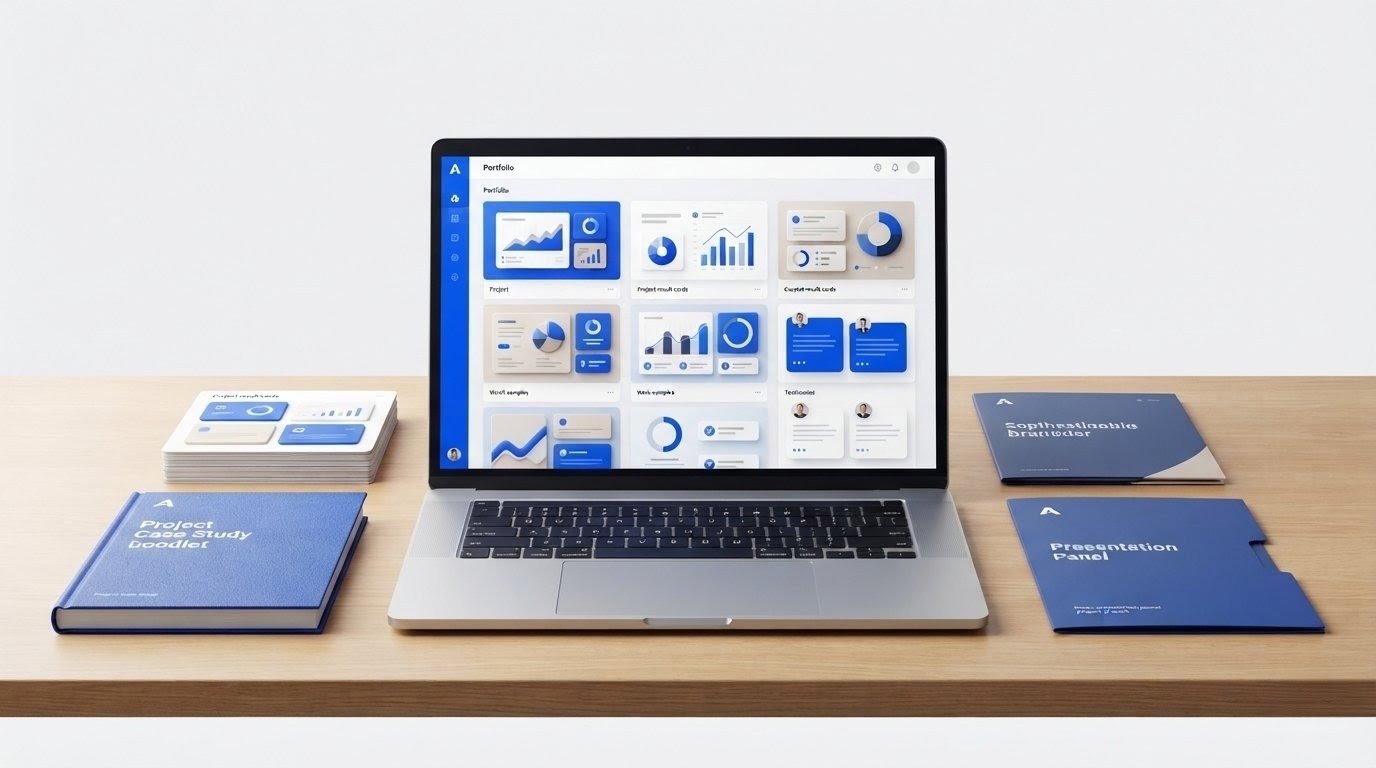
High-paying clients want evidence, but evidence doesn’t have to come from a marketplace.
Three sources work well. First, a small number of detailed case studies, even from discounted or pro bono work, showing the problem, your process, and a measurable result. Second, testimonials that name a real person, role, and company, with permission. Third, public work: open-source contributions, published articles, a teardown of a well-known site’s checkout flow, a data analysis shared on LinkedIn.
If you have no client work yet, build a clearly labelled sample project. Hypothetical example: you’re a conversion copywriter, so you rewrite the landing page of a public SaaS tool, document your reasoning, and say plainly that it’s a spec exercise and not a paid engagement. Labelled honestly, that’s useful. Passed off as client work, it’s a trust-killer.
A one-page portfolio site on your own domain beats a long profile on any directory. Include your offer, two or three case studies, a short bio, one clear way to contact you, and a privacy notice if you collect any data.
LINKEDIN AS A CLIENT-FINDING TOOL

LinkedIn is one of the strongest direct channels for B2B freelancers because it combines professional identity, company information, publishing, networking, and prospect research in one place. It works well across the US, UK, Europe, India, the Gulf states, and increasingly Africa.
Fix your profile first. Your headline should state who you help and how, not just your job title. The first two lines of your About section matter most, since that’s what shows before the “see more” fold. Pin a featured case study and a booking link.
Then use it in three layers.
Visibility. Post two to three times a week about problems your ideal client faces. Share a mistake you’ve seen in your field, a short breakdown of a public campaign or product, or a lesson from a real project (anonymised if needed). Don’t chase viral engagement. Ten comments from potential buyers beat a thousand likes from fellow freelancers.
Relevance. Comment thoughtfully on posts by your target clients and the people they follow. A useful comment on a marketing director’s post gets noticed far more reliably than a cold pitch.
Direct contact. Connect with a short, specific note, and wait before pitching. A decent pattern: connect, engage with a post or two over a week or so, then send a brief message that references something real about their business and asks a simple question.
Slow-burn, yes. But practitioners commonly report that warm LinkedIn conversations convert to calls at noticeably higher rates than cold email alone. We couldn’t find a single reliable public statistic for this, so treat it as experience-based guidance and test it yourself.
OUTBOUND EMAIL DONE PROPERLY
Cold email still works when it’s targeted, short, and honest. It fails when it’s mass-blasted.
What a good message looks like: three to five sentences. Open with something specific about the recipient’s company (not “I hope this finds you well”). State the problem you think they may have. Offer one relevant proof point. Ask a low-pressure question.
Sample structure (illustrative, adapt freely):
“Hi Maria, I noticed your team launched the new pricing page in March and that the free trial button now sits below the fold on mobile. I help B2B software companies lift trial signups through layout and copy changes; for one client, signups rose 18% over eight weeks. Would it be useful if I sent over a two-minute Loom with three ideas for your page?”
That 18% figure is a placeholder; use only real results you can back up.
Rules worth following. Send in small batches of 20 to 30 well-researched prospects, not thousands. Warm up a dedicated sending domain and avoid sending from your main business address. Include your real name, location, and an easy opt-out. Follow up twice, spaced four to seven days apart, then stop.
Response rates vary widely. Sales-tool vendors and practitioners often cite reply rates of a few percent for generic outreach and noticeably higher for tightly researched messages, but published figures differ and many come from vendors with an interest in the answer.
Plan for modest numbers: if you send 100 good emails and get five replies and two calls, that’s a healthy start.
Warning
In the UK, PECR generally allows unsolicited B2B email to corporate subscribers provided you identify yourself and offer an opt-out, but sole traders and some partnerships are treated differently. The ICO’s B2B marketing guidance explains these distinctions.
In the EU, rules vary by country, and the European Commission’s guidance on legal grounds for processing data is a useful starting point. In the US, CAN-SPAM requires a physical address and an opt-out. Check rules for each country you target.
REFERRALS: THE QUIET MAJORITY OF HIGH-VALUE WORK
Ask experienced freelancers how they get their best clients, and referrals come up again and again. It’s anecdotal, but it’s consistent across communities.
Don’t wait passively. Build a short list of 20 to 30 people who regularly meet your ideal clients: accountants, fractional CFOs, web agencies, recruiters, product consultants, bookkeepers, and former colleagues. Tell each one exactly what you do and what a good referral looks like. Make it easy: a two-line description they can forward.
A mistake many make: asking “do you know anyone who needs a freelancer?” That’s too vague to act on. Ask instead, “Do you know any e-commerce brands doing over $2M a year who are struggling with abandoned carts?”
Offer a thank-you where appropriate and legal. Some referrers like a fee, some prefer a favour in return, and many ask for nothing. Disclose any arrangement where local advertising or consumer-protection rules require it.
PARTNERSHIPS WITH COMPLEMENTARY SPECIALISTS
A web developer and a conversion copywriter serve the same client at different points. A bookkeeper and a financial planner share customers. Quietly forming a small circle of non-competing specialists produces a steady flow of warm introductions.
Be selective. Partner only with people whose work you’ve seen and would stake your own reputation on. One bad handoff damages the relationship with the client, and it’s yours to repair.
CONTENT THAT ATTRACTS CLIENTS, NOT JUST READERS
Writing publicly helps when it’s aimed at buyers. A newsletter, a blog on your own site, a recurring LinkedIn series, or a niche podcast can all work. Don’t try all four.
Aim content at questions your clients type into Google: “how much does a Shopify migration cost,” “AI tools for invoice processing,” “should I hire a fractional marketer.” Answer honestly, including when the answer is “it depends” and why. Cost transparency tends to attract serious buyers and filter out those with unrealistic budgets.
Search takes time. Expect three to six months before a new article ranks for anything meaningful, and some never will. LinkedIn and email distribution give faster feedback, so use them to test topics before investing in long articles.
AI tools can speed up research and drafting, but treat their output as a draft. Check every statistic, remove generic phrasing, and add your own experience and examples. Clients hire you for judgement, and readers can usually tell when no one with judgement has reviewed a piece. For research support, see our guide to AI tools that are changing freelance work.
COMMUNITIES, EVENTS, AND PODCASTS
Industry conferences, local chambers of commerce, coworking spaces, and online groups all put you near buyers. Slack and Discord communities in niche industries (e-commerce operators, SaaS founders, healthcare administrators) are often better than large generalist forums.
Contribute before selling. Answer questions, share a resource, introduce people to each other. Then, when someone mentions a problem you solve, a direct message feels natural.
Speaking can accelerate trust because potential clients can hear you demonstrate your expertise before they ever book a call. An audience hears you solve a problem live, and a few will message you afterwards. Podcast hosts are constantly looking for guests with specific expertise, and a short, relevant pitch is often welcome.
AGENCIES, SUBCONTRACTING, AND WHITE-LABEL WORK
This one’s often overlooked. Agencies and consultancies frequently run short on capacity and need reliable specialists. Subcontracting pays less per hour than direct work with an end client, often by a third or more, but it’s steadier and removes the sales burden.
It works well as a bridge in the first six months or as a permanent part of the mix. Be clear about rates, non-compete clauses, and who owns client relationships. Some agencies restrict you from approaching their clients; read contracts carefully.
PRICING AND PROPOSALS THAT HOLD UP
Hourly pricing penalises efficiency. If AI tools help you finish in five hours what once took fifteen, charging by the hour cuts your income exactly when your skill improves.
Consider three alternatives. Fixed-price projects with clear scope. Value-based pricing tied to the business outcome—some consultants anchor value-based fees to a fraction of the economic value created, but there is no universal percentage. Use the client’s expected outcome, risk, scope, alternatives, and your level of responsibility to set the fee. Retainers for ongoing work, which give you predictable income and give the client priority access.
Brennan Dunn, who runs Double Your Freelancing, has written publicly about moving from hourly work to project and retainer models; his material is a good starting point if you want case-based detail.
A proposal should fit on two pages. Cover the problem in the client’s words, your proposed approach, deliverables, timeline, price, and what happens if scope changes. Offer three options when appropriate: a basic, a recommended, and a premium. Many buyers choose the middle one.
For many project-based engagements, requesting an upfront deposit—often 30% to 50%—can reduce cash-flow risk, provided the arrangement fits the project and local contract rules. A client who won’t pay a deposit is telling you something.
GETTING PAID ACROSS BORDERS
Payment friction can cost you real money. Common options include Wise (multi-currency accounts and local bank details in several currencies; see Wise business pricing), Stripe invoicing (cards and bank debits; availability depends on your country), PayPal (widely accepted but with higher fees), Payoneer (popular in parts of Asia, Africa, and Eastern Europe), and direct bank transfer through SWIFT (slow and sometimes costly). For a broader look at financial tools, see our roundup of AI finance tools.
| Method | Best For | Main Consideration |
|---|---|---|
| Wise | Bank transfers / multi-currency | Availability + conversion fees |
| Stripe | Invoices / card payments | Country support |
| PayPal | Familiar global payments | Fees |
| Payoneer | Cross-border freelancer payments | Availability + fees |
| SWIFT | Traditional bank transfers | Bank fees + processing time |
Invoice in the client’s currency when that helps them approve it, but understand your exposure to exchange-rate swings. For projects longer than a couple of months, consider pricing in a stable currency such as USD or EUR.
Check which tax documents clients may request. US companies hiring non-US freelancers typically collect a Form W-8BEN; US-based freelancers get a W-9 request and a 1099 at year end if they cross the threshold. EU businesses may need your VAT number for the reverse-charge mechanism. In the UK, clients working with individuals may ask about IR35 status, which determines whether you’re treated as genuinely self-employed for tax purposes.
TOOLS AND REAL COSTS
A lean stack covers most needs: a domain and simple site ($15 to $60 a year for the domain, hosting from free to $20 a month), a CRM such as HubSpot’s free tier or Notion (see our guide to AI CRM tools), an email tool, a scheduling link (Calendly or Cal.com), an invoicing tool, and a document signer. Sales Navigator is optional early on; current official pricing starts around US$119.99/month for Core in the US, with regional pricing varying.
One practical note on AI tools: they’re useful for research, summarising a prospect’s website, drafting variations of an email, and preparing for calls (see our guide to making money with ChatGPT). They’re a poor substitute for knowing your prospect. Generic AI-written outreach has become easy to spot, and recipients increasingly ignore it.
THREE MISTAKES THAT COST FREELANCERS MONTHS
These come up so often in freelancer communities and in published advice that they’re worth naming plainly.
Mistake one: pitching before researching. Sending the same message to hundreds of people gets deleted, and in some regions it creates legal exposure. The fix is boring: spend 10 minutes per prospect before writing a word.
Mistake two: quitting after two weeks. Direct acquisition compounds. A LinkedIn post from week two might lead to a conversation in week twelve. Many freelancers stop right before the curve turns.
Mistake three: underpricing the first direct client out of relief. It feels safe to take $800 when you’d hoped for $3,000. But a low first price anchors the relationship, attracts clients who value you less, and makes raises awkward. If you want to offer a discount to get a case study, label it as such and set an end date.
HIDDEN COSTS AND RISKS
Unpaid time is the biggest one. Prospecting, calls, proposals, and admin often take 30% to 50% of a new freelancer’s week. Client concentration is another: one client representing more than half your income is fragile. Scope creep eats profit when contracts are vague. Late payments hit cash flow, so set payment terms at 14 days or less where you can, and consider late fees allowed by local law.
Legal and tax mistakes are expensive. Misclassifying yourself, missing VAT registration thresholds, or ignoring foreign withholding rules can create bills later. A one-hour consultation with an accountant familiar with cross-border work is cheap insurance.
There’s also a human cost. Direct outreach means rejection, silence, and slow weeks. Build a routine that doesn’t depend on how the last email went.
HOW LONG THIS REALISTICALLY TAKES
A reasonable path for someone with a solid skill and a small network: month one is spent on positioning, a site, and first outreach; month two brings the first real conversations; month three or four may bring one or two paid projects; by month six, a steady pipeline of three to five active conversations is a realistic target.
Some people move faster, especially with strong existing contacts. Others take nine to twelve months. If someone promises results in 30 days, be skeptical.
YOUR 90-DAY GLOBAL ACTION PLAN
| Period | Main Goal | Actions | Target |
|---|---|---|---|
| Days 1–14 | Positioning | Offer, niche, site, LinkedIn | Foundation |
| Days 15–30 | Warm network | 50 contacts | Conversations |
| Days 31–45 | Outreach | 60 prospects | Replies |
| Days 46–60 | Sales | Calls + proposals | Opportunities |
| Days 61–75 | Authority | Content + partnerships | Warm leads |
| Days 76–90 | Optimization | Review + double down | Better pipeline |
Days 1–14: Positioning and foundations. Write your two-sentence offer. Pick one niche and one region or two. Build or refresh a one-page site. Update your LinkedIn headline and About section. Draft one case study (real or labelled sample). Set up a CRM and a simple tracking sheet.
Days 15–30: Warm network. List 50 people from past jobs, clients, classmates, and communities. Message 10 per week with a short, specific update about what you do now. Ask for one introduction each. Start posting on LinkedIn twice a week.
Days 31–45: Targeted outreach. Build a list of 60 prospects that match your ideal client profile. Research each for 10 minutes. Send 20 personalised emails or LinkedIn messages a week. Log every response.
Days 46–60: Calls and proposals. Run discovery calls with a simple structure: their goal, what they’ve tried, budget range, decision process. Send proposals within 48 hours. Follow up twice.
Days 61–75: Content and partnerships. Publish a short case study or teardown. Contact five complementary specialists or small agencies. Join one niche community and contribute weekly.
Days 76–90: Review and refine. Count what worked: replies, calls, proposals, wins. Drop the channel that produced the least. Double down on the best one. Raise your rates for new inquiries by 10% to 20% if demand is healthy. Set a goal for the next 90 days.
YOUR COMPREHENSIVE CHECKLIST
Comprehensive Checklist
- One clear offer in two sentences
- Target client profile (industry, size, role, region)
- One-page site on your own domain
- LinkedIn profile rewritten for buyers
- At least one case study or labelled sample
- List of 50 warm contacts
- List of 60 targeted prospects
- CRM or tracking sheet
- Cold email template (personalised each time)
- Opt-out process and basic data-handling record (GDPR/UK GDPR/CCPA)
- Proposal template with three pricing options
- Contract template reviewed by a professional
- Invoicing and payment setup in at least two currencies
- Tax registration status confirmed with an accountant
- Weekly outreach target and review day
US freelancers should check state-level rules and consider an LLC; UK freelancers should confirm sole trader versus Ltd and IR35 considerations; EU freelancers should confirm VAT status; Asia-Pacific and Middle East freelancers should confirm local licence requirements; African freelancers should confirm cross-border payment options before quoting.
REGIONAL CONSIDERATIONS
United States: The largest single market for freelance services in most fields. Buyers expect clear pricing, fast replies, and written agreements. Common structures are sole proprietorship, LLC, or S-corp for higher earners. Self-employment tax is a significant cost; an accountant familiar with quarterly estimates is worth it. Be aware that some states apply different contractor-classification tests.
United Kingdom: Sole traders and limited companies are both common. HMRC rules and IR35 can affect how you’re taxed when working for medium and large clients. Payment terms of 30 days are typical, though you can negotiate shorter. VAT registration becomes mandatory above the government threshold, which changes periodically, so check HMRC.
European Union: GDPR applies to anyone processing EU residents’ data. VAT rules for cross-border services are complex; B2B services are often subject to reverse charge, but check each case. Languages matter: offering services in German, French, or Spanish can open doors that English alone doesn’t. Work culture varies; Northern European buyers may prefer concise, formal communication, while Southern European markets often value relationship-building before commitment.
Asia-Pacific: Large and varied. Singapore, Australia, and Hong Kong have well-developed freelancer ecosystems and English-friendly business environments. In Japan, South Korea, and parts of Southeast Asia, introductions through trusted contacts carry extra weight and cold outreach may land less well. Australian freelancers should look at ABN registration and GST thresholds. Time zone overlap with Western clients is a practical consideration worth discussing early.
Middle East: Business hubs such as Dubai, Abu Dhabi, Riyadh, and Doha host many multinational firms and growing startups. Free zones offer licensing options for freelancers in some cases, but rules differ by emirate and country, so verify locally. Relationship-based selling matters, and in-person or video meetings often come before contracts. Payment terms may be longer than in the West.
Africa: A fast-growing digital economy, with strong technology clusters in Lagos, Nairobi, Cape Town, Cairo, and Accra, among others. For freelancers based there, payment access is the main practical issue; test your receiving method with a small invoice before a big project. For freelancers selling to African clients, mobile money and local payment methods are often more common than cards. Currency volatility in some countries argues for pricing in USD or EUR.
FREQUENTLY ASKED QUESTIONS
Use LinkedIn, referrals, targeted email outreach, niche communities, content, and partnerships with agencies or complementary specialists. Combine two or three channels and stay consistent for at least three months before judging results.
Most people starting from a small network need about two to four months for the first project from outreach, though warm contacts can shorten that. Treat any timeline as an estimate; skill level, niche, and market all change it.
In many countries, yes, for business-to-business contact, subject to local rules. In the US, CAN-SPAM requires an opt-out and a physical address. In the UK and EU, PECR and GDPR apply and details differ by country. Check rules before contacting prospects, and stop immediately when someone opts out.
It depends on field and experience. Instead of copying an average, research five to ten public rate sources in your niche, set a project price tied to value, and test it with new inquiries. Raise it if you’re winning nearly every proposal.
IR35 is the set of rules HMRC uses to decide whether a contractor working through a company should be taxed like an employee. It’s mostly relevant for medium and large clients. Get professional advice if you work through a limited company.
Yes. Many freelancers serve clients in the US, UK, and EU from these regions. Focus on time-zone overlap, reliable payment methods, and clear communication, and confirm local licensing and tax rules.
You need a place you control that explains your offer and shows proof. A one-page site on your own domain is enough to start.
Use it for research and rough drafts, then rewrite in your own voice. Generic AI-written emails are easy to spot and often get ignored.
FINAL SUMMARY
Finding high-paying freelance clients without platforms isn’t a trick. It’s a business habit: pick a narrow offer, find the people with budgets, show proof, reach out respectfully, and follow up. Each step is ordinary. The compound effect isn’t.
The honest part is the slow part. Expect a few quiet months, a handful of rejections for every yes, and some awkward early pricing conversations. That’s normal, not a sign you’re failing. The freelancers who build durable direct pipelines are usually the ones who kept sending, posting, and following up through the dull stretch.
Realistic potential varies by region and field, but plenty of specialists reach a point where two or three strong direct clients replace what a dozen platform gigs once paid, and they do it with fewer hours. That outcome isn’t guaranteed, and anyone who says it is should be treated with caution.
If you do one thing this week, write your two-sentence offer and send ten thoughtful messages to people who might need it. From there, the 90-day plan above gives you a structure to build on.
At AiMoneyGuideCo, our mission is to give independent professionals around the world practical, verifiable strategies for building income that doesn’t depend on a single platform, employer, or algorithm. Finding your own clients is one of the most solid foundations you can lay for that, and the earlier you start, the sooner it pays off. For freelancers exploring broader income models, see our guides to building passive income with AI tools and making money selling digital products.
- READ THIS BEFORE YOU START
- WHAT “HIGH-PAYING” MEANS IN 2026
- WHY PLATFORMS CAP YOUR INCOME
- START WITH A NARROW OFFER
- WHO HOLDS THE BUDGET
- BUILD PROOF WITHOUT A PLATFORM PROFILE
- LINKEDIN AS A CLIENT-FINDING TOOL
- OUTBOUND EMAIL DONE PROPERLY
- REFERRALS: THE QUIET MAJORITY OF HIGH-VALUE WORK
- PARTNERSHIPS WITH COMPLEMENTARY SPECIALISTS
- CONTENT THAT ATTRACTS CLIENTS, NOT JUST READERS
- COMMUNITIES, EVENTS, AND PODCASTS
- AGENCIES, SUBCONTRACTING, AND WHITE-LABEL WORK
- PRICING AND PROPOSALS THAT HOLD UP
- GETTING PAID ACROSS BORDERS
- TOOLS AND REAL COSTS
- THREE MISTAKES THAT COST FREELANCERS MONTHS
- HIDDEN COSTS AND RISKS
- HOW LONG THIS REALISTICALLY TAKES
- YOUR 90-DAY GLOBAL ACTION PLAN
- YOUR COMPREHENSIVE CHECKLIST
- REGIONAL CONSIDERATIONS
- FREQUENTLY ASKED QUESTIONS
- FINAL SUMMARY
Join the Discussion
0 comments
Share a question, a tip or what worked for you. Please keep it helpful and on topic.
No comments yet. Be the first to share your thoughts.